Why Stories Solve the Engagement Gap in Fundraising
Platform engagement gaps frustrate many nonprofits. You post important updates, your community reacts politely, and then the momentum disappears before it becomes action. That is exactly why Instagram & Facebook Stories to raise funds deserves serious attention. Stories are built for fast, mobile-first, full-screen interaction, and Meta describes Stories as an immersive format across Facebook, Messenger, and Instagram that disappears within 24 hours unless saved. Meta also notes that Page Stories help organizations connect more frequently in a more authentic and casual way.
For fundraising teams, that matters because donors do not always need a polished campaign page first. Often, they need a reason to care right now. Stories create that urgency. They sit at the top of the app, feel personal, and allow supporters to move from awareness to action with fewer steps. Meta’s nonprofit fundraising materials also explain that Instagram enables donations through profile tools while supporters can raise money through Stories, Live, Reels, and feed content.
The biggest mistake nonprofits make is treating Stories like disposable leftovers from their main content calendar. In reality, Instagram & Facebook Stories to raise funds works best when Stories are treated as a live fundraising channel: quick, human, emotionally clear, and built for response. When your feed educates but your Stories activate, you close the gap between attention and giving.
What makes Stories different from regular posts
Feed posts are excellent for visibility and permanence. Stories are excellent for immediacy. Because they are temporary, supporters pay attention faster. Because they are vertical and immersive, they feel closer to a one-to-one conversation than a public announcement. Because Stories support interactive elements such as stickers and fundraising tools, they can turn a viewer into a participant. Meta’s nonprofit toolkit specifically highlights tools such as the Support button, nonprofit fundraisers, Story donation stickers, and Live donations as part of the fundraising ecosystem.
That is why Instagram & Facebook Stories to raise funds is not just a content tactic. It is a response tactic. It helps you reach supporters in moments when they are ready to tap, reply, share, donate, or send the Story to someone else.
Why engagement gaps happen in the first place
Most engagement gaps are not caused by lack of mission value. They are caused by friction. The story is too broad. The ask comes too late. The donation path is unclear. The creative is overdesigned. The audience sees a cause but not a moment.
Stories fix that by forcing clarity. In a Story, you cannot hide behind long paragraphs. You need one message, one emotional hook, and one next step. That discipline is useful. It makes your fundraising sharper.
The role of native fundraising tools
A major reason Instagram & Facebook Stories to raise funds can work so well is that Meta has built native donation options into the ecosystem for eligible nonprofits and supporters. Meta’s fundraising toolkit says people can support nonprofits through Instagram profile tools, Story donation stickers, Live donations, and fundraisers that can also be shared across content formats. The same toolkit also states that Facebook and Instagram do not charge fees for processing donations to nonprofits.

That combination matters. When donation action stays close to the content, the supporter has fewer chances to drop off.
Start with one fundraising objective, not ten
Before designing anything, decide what this Story series is supposed to do. The strongest Instagram & Facebook Stories to raise funds campaigns usually focus on one of these:
1. Convert warm followers into first-time donors
This is your best starting point. Use Stories to speak to people who already know your organization but have never given. They do not need a full institutional history. They need a clear reason to act today.
2. Re-engage past supporters
Stories are excellent for reminding dormant supporters that your work is still active, urgent, and making progress.
3. Mobilize peer-to-peer support
Meta’s nonprofit toolkit emphasizes that supporters can run fundraisers for nonprofit causes and share them through Stories and other formats. That makes Stories especially effective for community-led fundraising, ambassador campaigns, or giving-day momentum.
Build a Story sequence, not a single Story
One Story slide rarely does the full job. A better structure for Instagram & Facebook Stories to raise funds is a 4-to-6-frame sequence:
Frame 1: Stop the scroll
Lead with a face, a moment, or a visual contrast. Avoid generic event photos. Show a person, a place, or a need.
Frame 2: Name the problem
Make the pain visible in one sentence. Example: “This week, 42 families still need emergency food support.”
Frame 3: Show what your nonprofit is doing
Prove action, not just intention. Use real images, short clips, or a staff voiceover.
Frame 4: Make the donor’s role obvious
Tell viewers what their gift does. Not “support our mission,” but “$20 provides transport for one clinic visit.”
Frame 5: Ask clearly
Use your fundraiser sticker, donation tool, or direct link path where available.
Frame 6: Reinforce urgency or gratitude
Say what happens next: “We are closing this appeal tonight” or “You helped us reach 68%.”
This sequence works because it mirrors how people decide: attention, understanding, trust, action.
Use creative tools that invite participation
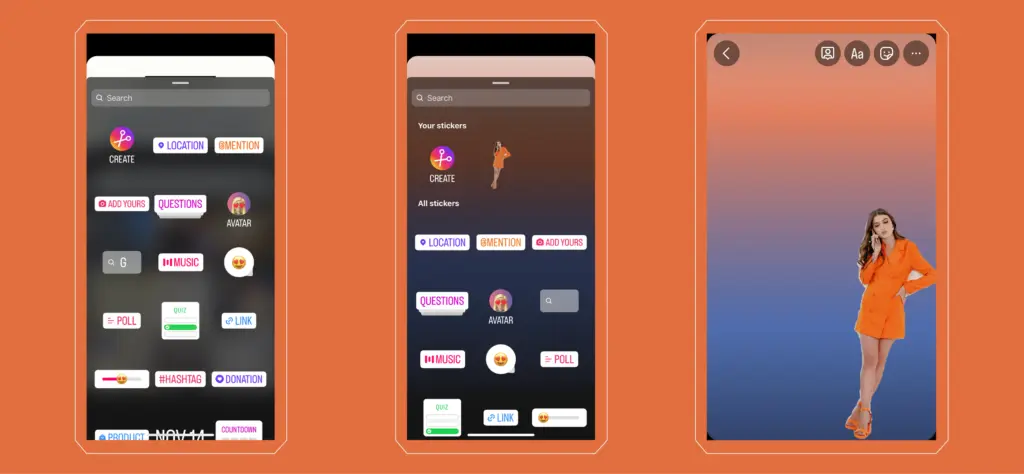
Instagram has continued expanding Story creativity with newer sticker options such as Add Yours Music, Frames, Reveal, and Cutouts, while Instagram’s own blog also highlights Story features like Add Yours, Layout, mentions, and backgrounds as ways to make Stories more engaging. These tools are not just decorative. Used well, they increase participation and make supporters feel involved rather than targeted.
For fundraising, participation matters because interaction often comes before donation. A supporter who replies, taps a sticker, or shares a Story is more likely to give later.
Story ideas that create movement
Use Instagram & Facebook Stories to raise funds with formats like these:
Behind-the-scenes proof
Show supplies being packed, staff preparing outreach, or volunteers arriving.
Micro-testimonials
Capture one sentence from a beneficiary, volunteer, or donor.
Progress updates
Share a simple fundraising thermometer or milestone number.
Countdown moments
Meta’s nonprofit toolkit specifically recommends using countdown stickers to help communities set reminders around fundraisers.
Supporter reshares
Meta’s toolkit also recommends re-sharing Stories from supporters running campaigns on your behalf to build momentum and extend reach.
Design for mobile first or lose attention

Stories are a vertical format, and Meta’s guidance for Stories placements emphasizes creative built for Story environments, including support for vertical dimensions and protection of key elements from interface overlap through safe zones. Meta also notes that safe zones matter so important text, logos, and visuals are not covered by the user interface.
That means your Instagram & Facebook Stories to raise funds content should follow a few rules:
Keep text brief
One idea per frame. One to two lines is often enough.
Leave breathing room
Do not place key text at the very top or bottom where interface elements may cover it.
Show faces early
Human faces usually outperform abstract graphics in trust-building content.
Use motion carefully
Even a slight camera movement or short video clip can feel more alive than a static poster.
Tell donor-centered stories, not organization-centered ones
Nonprofits often default to “we” language. But Instagram & Facebook Stories to raise funds becomes more effective when it uses donor-centered framing. The question is not “What do we want to announce?” It is “What can the supporter change by acting now?”
Instead of:
“We are proud to launch our seasonal campaign.”
Try:
“Tonight, a child in our program can receive school supplies because someone watching this story decides to help.”
This does not mean manipulating emotion. It means making impact understandable. Donors are not inspired by internal updates alone. They are inspired by a visible bridge between need and response.
Use urgency without sounding desperate
Stories naturally create urgency because they expire. Meta’s explanation of Stories as disappearing within 24 hours supports why this format works well for time-bound prompts.
Use that temporary nature wisely in Instagram & Facebook Stories to raise funds:
Good urgency
“Help us close the final 20% by midnight.”
Better urgency
“Eight children still need transport support before Monday clinic visits.”
Weak urgency
“Please donate if you can.”
Urgency works when it is specific. Vague requests feel optional. Concrete asks feel real.
Pair Stories with your profile infrastructure
Stories do not work in isolation. Meta’s nonprofit toolkit explains that eligible organizations can activate a Support button on their Instagram profile, and it outlines steps such as using an Instagram Business account and linking it to a verified Facebook Page. The toolkit also notes that fundraising tools have eligibility requirements and that review can take weeks.
So when using Instagram & Facebook Stories to raise funds, make sure your profile is ready:
Your bio should explain the mission fast
Viewers often tap to your profile before donating.
Your support or donation pathway should already be active
Do not run a Story campaign with a broken profile journey.
Your highlight folders should reinforce trust
Save previous Stories into highlights such as “Impact,” “Give,” or “Results.”
Repurpose Stories across the donor journey
A high-performing Story should not vanish forever just because 24 hours passed. Turn your best Instagram & Facebook Stories to raise funds content into:
Highlights
Save evergreen donor stories, campaign explainer slides, and proof-of-impact clips.
Reels
If a Story sequence performs well, adapt it into a Reel with stronger reach potential.
Feed carousels
Convert educational Story series into swipe posts for longer-term visibility.
Email creative
A strong Story narrative often becomes a powerful email opener or appeal paragraph.
Measure the right things

Do not judge Instagram & Facebook Stories to raise funds only by likes. Stories are about movement, not vanity metrics.
Track:
Completion rate
Are viewers making it through all frames?
Sticker taps or donation interactions
Are people engaging with the fundraising mechanism?
Replies and shares
These are often signs of emotional resonance.
Profile visits
A strong signal that your Story sparked intent.
Donations and attributed conversions
The final measure, when available.
A Story with fewer views but more replies and taps may be far more valuable than one with broad passive reach.
A simple weekly Story fundraising plan
Here is a practical rhythm for Instagram & Facebook Stories to raise funds without burning out your team:
Monday: Mission moment
Show one real story from the field.
Tuesday: Quick fact
Name a problem with one strong data point.
Wednesday: Behind the scenes
Show action in progress.
Thursday: Community voice
Feature a volunteer, donor, or supporter Story.
Friday: Ask day
Use a direct fundraising prompt with urgency.
Weekend: Gratitude and progress
Thank supporters and show what gifts are making possible.
This structure keeps your audience warm while giving you repeated opportunities to ask.
Common mistakes to avoid

Turning every Story into a poster
Stories should feel native, not like squeezed-down flyers.
Asking too early
Build emotional context before the donation prompt.
Using vague impact language
Replace “make a difference” with a concrete result.
Ignoring supporter-created content
Meta’s nonprofit guidance specifically encourages re-sharing supporter fundraisers and Stories to extend reach and momentum.
Forgetting the Facebook side
Do not focus only on Instagram. Facebook Stories can still help you reach existing supporters who are more active there.
Also read:How to Use Facebook & Instagram Fundraisers Successfully
Wrap Up
If your nonprofit is facing platform engagement gaps, Instagram & Facebook Stories to raise funds can be one of the simplest ways to turn passive attention into real donor action. Stories work because they are immediate, personal, visual, and built for interaction. They let you show the problem, prove the work, and present a clear next step without forcing supporters through a long attention journey first.
The key is not posting more random Stories. The key is posting better fundraising Stories: shorter, clearer, more human, and more action-oriented. When you treat Stories as a live response channel rather than a casual extra, they stop being filler content and start becoming a meaningful revenue pathway.
FAQs
1. What is the best way to use Instagram & Facebook Stories to raise funds?
The best approach is to use a short sequence that moves from emotion to action: hook attention, explain the need, show your response, and make a clear donation ask.
2. Do Stories really work for nonprofit fundraising?
Yes. Stories are built for real-time engagement, and Meta provides native fundraising tools for eligible nonprofits and supporters across Instagram and Facebook ecosystems.
3. How often should nonprofits post fundraising Stories?
A few times each week is a healthy starting point. Consistency matters more than overload.
4. Can supporters help us fundraise through Stories?
Yes. Meta’s nonprofit fundraising toolkit says supporters can create nonprofit fundraisers and share them through Stories and other formats.
5. Should we use polished graphics or raw video?
Usually a mix works best, but raw, human, in-the-moment visuals often feel more trustworthy in Stories.
6. Are donation stickers available to every nonprofit?
No. Meta notes there are eligibility requirements, country availability limits for some tools, and review processes for fundraising access.
7. What should we put on the first Story frame?
Lead with a face, a moment, or a single urgent statement that makes someone stop tapping.
8. How do we make Story donation asks feel less repetitive?
Alternate between impact updates, behind-the-scenes proof, supporter voices, countdowns, and gratitude posts before repeating the ask.
9. What size should Story visuals be?
Stories are designed for vertical viewing, and Meta’s Story placement guidance supports vertical creative while recommending safe zones to prevent important elements from being covered.
10. What is the biggest mistake nonprofits make with Stories?
Treating Stories like leftover content instead of a strategic fundraising channel. The strongest results come from intentional sequences, not random posts.