Nonprofits lose millions of dollars each year not because their missions lack impact—but because proposals miss the mark. One of the most common (and costly) reasons? Misunderstanding the difference between government grants and foundation grants.
At first glance, both appear to offer funding for good work. In practice, they operate under fundamentally different expectations, decision-making processes, and success criteria. Treating them the same is a fast way to get rejected—often without feedback.
This guide breaks down what you must know about government vs. foundation grants so you can align your strategy, language, and proposal design with the right funder—and dramatically improve your odds of success.
Also Read: The Anatomy of a Donor-Winning Logic Model or Theory of Change
Why This Difference Matters More Than You Think
Many nonprofits apply to both government and foundation grants using slightly tweaked versions of the same proposal. This approach feels efficient—but it’s one of the biggest hidden funding killers.
Here’s why:
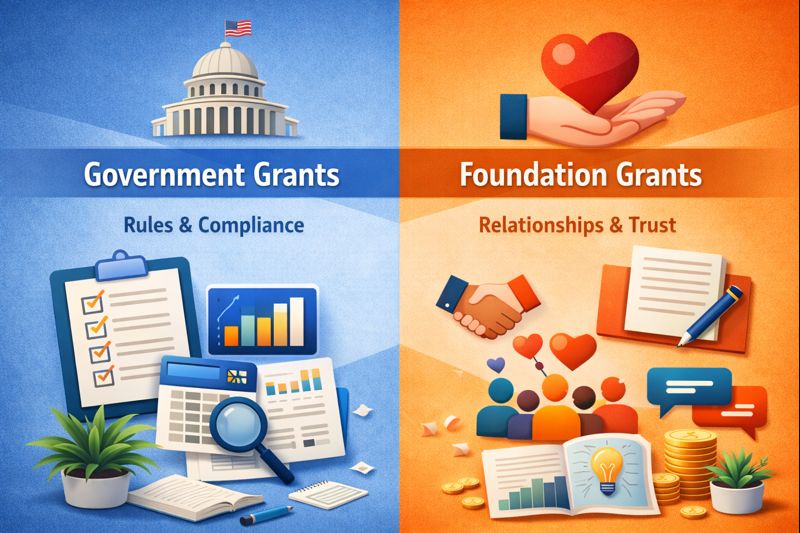
- Government funders prioritize compliance, scale, and accountability
- Foundations prioritize mission alignment, trust, and outcomes
- Each uses different review processes, timelines, and risk tolerances
- Each expects a different voice, structure, and proof of impact
Fail to adjust, and even strong programs can look unqualified or misaligned.
What Is a Government Grant?
Government grants are public funds distributed by federal, state, or local agencies to advance policy goals.
Core Characteristics of Government Grants
1. Rule-driven and compliance-heavy
Government grants are governed by legislation, regulations, and formal procurement rules. Every requirement matters.
2. Highly structured applications
Expect strict formatting, page limits, scoring rubrics, and mandatory attachments.
3. Objective scoring systems
Applications are evaluated against predefined criteria, often by multiple reviewers.
4. Emphasis on scale and systems
Government funders want solutions that can operate at scale, demonstrate sustainability, and withstand audits.
5. Slower timelines
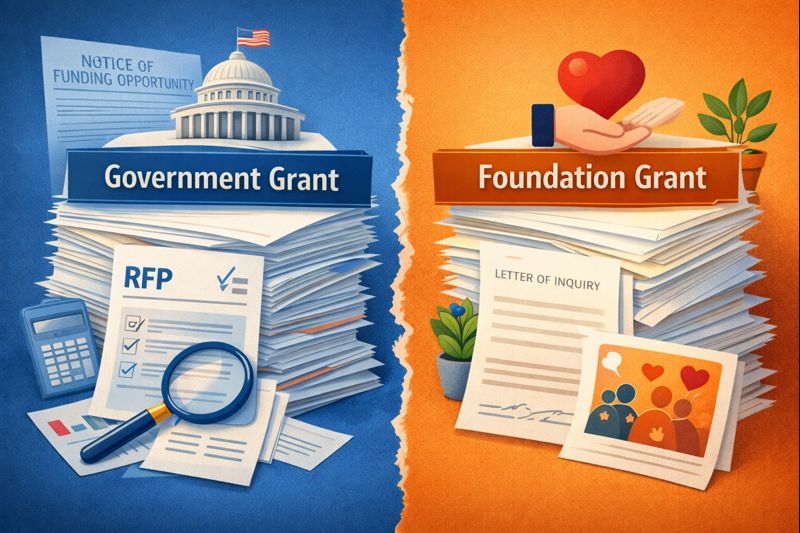
From notice of funding opportunity (NOFO) to award can take months—or longer.
What Government Funders Expect (But Rarely Say Explicitly)
- Proven organizational capacity
- Strong financial controls
- Clear logic models
- Evidence-based or evidence-informed programs
- Risk mitigation strategies
- Alignment with public policy objectives
In short: “Can this organization responsibly manage taxpayer money?”
What Is a Foundation Grant?
Foundation grants are private funds distributed by philanthropic organizations—family foundations, corporate foundations, or independent philanthropies.
Core Characteristics of Foundation Grants
1. Relationship-driven
Trust, reputation, and alignment matter deeply.
2. Flexible application processes
Some foundations use formal applications; others rely on letters of inquiry or personal introductions.
3. Subjective decision-making
Boards, trustees, or program officers may weigh values and vision as much as metrics.
4. Focus on impact, innovation, or community change
Foundations are often willing to fund pilots, advocacy, or niche interventions.
5. Faster (but less predictable) timelines
Decisions may come quickly—or pause indefinitely.
What Foundations Expect (But Often Don’t Spell Out)
- Deep mission alignment
- Authentic storytelling
- Leadership credibility
- Community-rooted impact
- Values consistency
- Emotional resonance and outcomes
In essence: “Do we believe in this organization and its leadership?”
Side-by-Side: Government vs. Foundation Grants
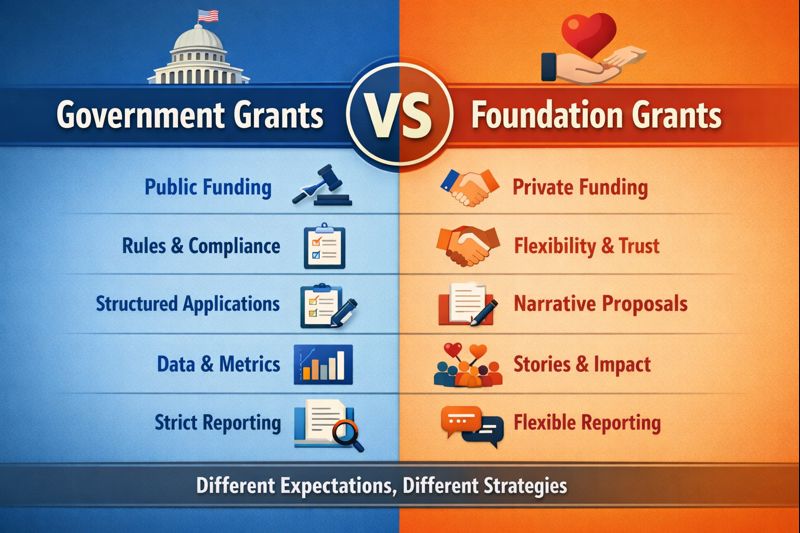
| Dimension | Government Grants | Foundation Grants |
| Funding Source | Public funds | Private philanthropy |
| Decision Logic | Rules-based | Relationship-based |
| Application Style | Formal, rigid | Flexible, narrative-driven |
| Risk Tolerance | Low | Moderate to high |
| Reporting | Extensive, ongoing | Varies widely |
| Tone | Technical, precise | Human, mission-focused |
| Review Process | Multi-level scoring | Board or officer discretion |
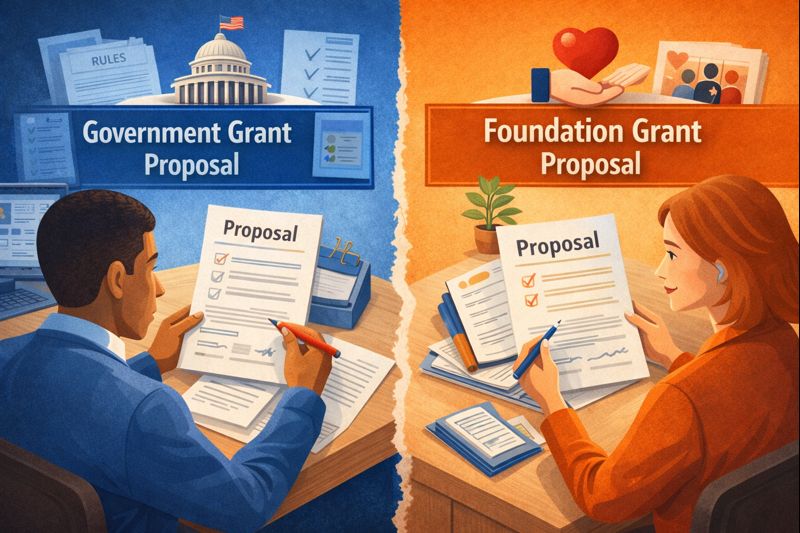
Understanding this contrast isn’t academic—it’s strategic.
The #1 Pain Point: Misaligned Funder Expectations
Most rejections stem from expectation mismatch, not program weakness.
Common Government Grant Mistakes
- Overemphasizing emotion instead of systems
- Under-documenting compliance capacity
- Vague budgets or outcomes
- Lack of measurable indicators
Common Foundation Grant Mistakes
- Writing like a government proposal
- Overloading with jargon and regulations
- Ignoring the foundation’s history or values
- Failing to connect leadership vision to impact
Different funders read proposals with different lenses. Your job is to write for the lens, not just the program.
How Language and Tone Should Change
This is where many nonprofits struggle.
Government Grant Language Should Be:
- Precise
- Evidence-based
- Structured
- Neutral in tone
- Metrics-forward
Foundation Grant Language Should Be:
- Clear but conversational
- Story-driven
- Values-aligned
- Community-centered
- Vision-oriented
Same program. Two completely different voices.
Strategy Shift: One Program, Two Narratives
High-performing nonprofits don’t rewrite everything from scratch—but they don’t reuse blindly either.
They develop:
- A core program framework
- Two narrative tracks:
- A compliance-first government version
- A mission-first foundation version
Modern grant teams increasingly use platforms like GrantWriterAI to scale this process—adapting tone, structure, and donor expectations without burning out staff or relying on expensive consultants.
The result? More proposals submitted, better alignment, and higher funding probability.
Budgeting Differences You Must Account For
Government funders often:
- Require detailed line-item budgets
- Disallow certain cost categories
- Demand cost matching or indirect cost caps
Foundations often:
- Allow more flexibility
- Fund general operating support
- Focus less on financial granularity and more on outcomes
Submitting a government-style budget to a foundation can signal rigidity. Submitting a vague budget to a government agency can be disqualifying.
Reporting & Accountability: Plan Ahead
Government Grants
- Regular financial reports
- Programmatic performance metrics
- Audits and compliance reviews
Foundation Grants
- Narrative impact reports
- Outcome summaries
- Relationship updates
Before applying, ask yourself:
“Can we sustain the reporting burden if awarded?”
Winning the grant is only the beginning.
Choosing the Right Grant for Your Organization
Not every nonprofit should pursue both.
Ask these questions:
- Do we have strong compliance systems?
- Do we have staff capacity for reporting?
- Is our program experimental or established?
- Do we thrive on relationships or structure?
Your answers should guide where you focus—not just where the money looks biggest.
Alignment Is the Real Advantage
The most successful nonprofits aren’t those with the best writers—they’re the ones who deeply understand funder psychology.
When you align:
- Expectations
- Language
- Structure
- Accountability
You stop guessing—and start winning.
When you’re ready to increase proposal volume, reduce writing costs, and align every application with funder expectations, explore GrantWriterAI and start free here.
Frequently Asked Questions (FAQs)
1. Can the same nonprofit apply for both government and foundation grants?
Yes, but proposals must be tailored. Using the same language and structure for both significantly reduces success rates.
2. Are government grants harder to win than foundation grants?
They are more competitive and compliance-heavy, but foundations can be equally selective due to limited funding and subjective decisions.
3. Which type of grant is better for small nonprofits?
Foundations are often more accessible to smaller organizations, especially those with strong community ties or innovative approaches.
4. Do foundation grants require less reporting?
Usually yes, but expectations vary widely. Some foundations are very hands-on with reporting and outcomes.
5. Should new programs target government or foundation funding first?
Foundations are typically better suited for pilots and early-stage programs, while governments prefer proven models.
6. Why do strong programs still get rejected?
Most rejections happen due to misalignment—not lack of impact. Understanding funder expectations is often the missing link.
7. Can foundations fund expenses that government grants will not?
Yes. Foundations often fund costs government grants restrict or prohibit, such as advocacy, capacity building, pilot programs, and general operating expenses.
8. Do government grants care about storytelling at all?
Yes—but only when it supports data and outcomes. In government proposals, storytelling should reinforce evidence, not replace it.
9. How important is prior funding history for each type of grant?
Government funders strongly value past performance on similar awards, while foundations may fund first-time grantees if trust and alignment are strong.
10. Can technology help manage both grant types effectively?
Absolutely. Grant technology platforms can adapt proposal language, structure, and compliance requirements to match different funders, reducing errors and burnout while increasing submission volume.