
From Grassroots Idea to Funded Movement: How Fiscal Sponsorship Helps Projects Scale
Many community projects begin with a simple idea: solve a local problem, serve a neglected group, test a creative solution, or respond quickly to an urgent need.
Then reality arrives.
You need a bank account.
You need donors.
You need grant eligibility.
You need financial reports.
You need someone to issue donation receipts.
You need compliance systems.
You may need payroll, insurance, bookkeeping, contracts, and governance.
This is where many promising projects slow down. Not because the idea is weak, but because the administrative structure is missing.
That is why learning How to Scale Your Project Using Fiscal Sponsorship can be a smart move for founders, community leaders, artists, organizers, researchers, and early-stage nonprofit teams.
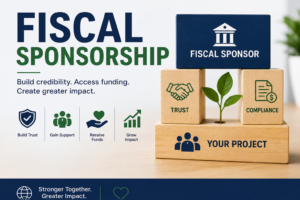
Fiscal sponsorship allows a project to operate under the legal and financial umbrella of an established nonprofit. The National Council of Nonprofits defines a fiscal sponsor as a nonprofit that provides fiduciary oversight, financial management, and other administrative services to help build the capacity of charitable projects.
In simple terms, your project can begin raising funds, receiving grants, and operating with more credibility before becoming its own independent nonprofit.
What Fiscal Sponsorship Means
Fiscal sponsorship is a formal relationship between an established nonprofit organization and a charitable project.
The sponsor usually has tax-exempt status. The project may be new, informal, small, or not yet ready to register as a separate nonprofit. Through the relationship, the sponsor receives donations or grants for the project, manages the funds, and ensures the money is used for approved charitable purposes.
The National Network of Fiscal Sponsors explains that fiscal sponsorship generally includes administrative services plus legal and financial accountability for mission-aligned work.
That matters because scaling is not only about raising more money. Scaling means building the structure to handle more money, more people, more programs, and more responsibility.
This is the first lesson in How to Scale Your Project Using Fiscal Sponsorship: structure creates speed.
Without structure, growth can become chaos. With the right fiscal sponsor, growth becomes more manageable.
Why Fiscal Sponsorship Helps Projects Grow Faster
Many people assume the first step to growth is forming a nonprofit. Sometimes that is true. But it is not always the best first move.
Creating a separate nonprofit can take time, money, governance capacity, and ongoing compliance. Fiscal sponsorship gives projects a way to begin doing the work while using the sponsor’s existing systems.
A sponsored project may be able to:
- Receive tax-deductible donations
- Apply for grants that require a nonprofit partner
- Use established financial management systems
- Build donor confidence
- Reduce early administrative burden
- Test the model before forming a separate organization
- Focus more energy on program delivery
A fiscal sponsorship arrangement can allow a project to seek grants and tax-deductible donations under the sponsor’s tax-exempt status, especially when the project does not yet have its own status.
This is why How to Scale Your Project Using Fiscal Sponsorship is not only a legal or accounting question. It is a growth strategy.
The Real Scaling Problem: Capacity, Not Just Money
Most early projects think they need more funding.
That may be true. But funding creates new demands.
When a project receives a larger grant, someone must track expenses. Someone must submit reports. Someone must protect donor restrictions. Someone must document outcomes. Someone must manage contracts. Someone must ensure that the project does not misuse charitable funds.
Growth without capacity can damage trust.
A fiscal sponsor can help close this gap by providing back-office support. Depending on the sponsor, this may include bookkeeping, accounting, HR, insurance, grant compliance, payroll, donation processing, and financial reporting.
Not every sponsor provides the same services, so project leaders should ask detailed questions before signing an agreement.
The key idea behind How to Scale Your Project Using Fiscal Sponsorship is simple: do not try to carry institutional responsibility with informal systems.
When Fiscal Sponsorship Makes Sense
Fiscal sponsorship is especially useful when your project is mission-driven but not yet ready to become a full nonprofit.

It may be a good fit when:
Your project is new and needs to test demand before forming a nonprofit.
Your work is urgent and cannot wait months for formal registration.
Your funders require a tax-exempt recipient.
Your team is small and cannot manage full compliance alone.
Your project is temporary, campaign-based, or event-based.
Your initiative fits naturally under the mission of an existing nonprofit.
Your team wants to learn nonprofit management before becoming independent.
Candid notes that fiscal sponsorship can be helpful for charitable initiatives that want to operate with nonprofit support before creating their own full structure.
If your goal is to build slowly, responsibly, and with less administrative pressure, How to Scale Your Project Using Fiscal Sponsorship may be the right path.
When Fiscal Sponsorship May Not Be the Best Fit
Fiscal sponsorship is powerful, but it is not perfect for every project.
It may not be the right choice if your project does not have a charitable purpose, does not align with the sponsor’s mission, needs full independence immediately, or cannot accept financial oversight.
A fiscal sponsor is not just a payment processor. The sponsor must maintain control over donated funds in a legitimate arrangement. The National Council of Nonprofits highlights that maintaining control over donated funds is a requirement of legitimate fiscal sponsorship.
This is important.
If you want unrestricted control with no reporting, fiscal sponsorship will feel frustrating. But if you want credibility, compliance, and a stronger platform for growth, the oversight can be an advantage.
The Main Fiscal Sponsorship Models
Fiscal sponsorship can take different forms. The exact model affects legal responsibility, decision-making, staffing, contracts, and money flow.
Model A: Direct Project Model
In Model A, the project is usually treated as part of the sponsor’s organization. The sponsor has legal and financial responsibility for the project. Staff may be employees or contractors of the sponsor. Donations are made to the sponsor for the project’s charitable purpose.
This model can be useful when the project needs deep administrative support and does not need separate legal independence.
Model C: Pre-Approved Grant Relationship
In Model C, the project may be a separate legal entity. The sponsor receives funds and then grants money to the project for approved charitable purposes. The sponsor must still ensure that the funds are used properly.
Nonprofit Law Blog explains that Model C can create risks when funders misunderstand the sponsor’s role or treat the relationship like a simple pass-through arrangement.
This is why agreements matter.
Choosing a model is not just a paperwork issue. It shapes how your project scales.
When studying How to Scale Your Project Using Fiscal Sponsorship, always ask: which model fits our future, not just our current need?
How to Choose the Right Fiscal Sponsor

A fiscal sponsor should be more than a name you place on a grant application.
The right sponsor can become a growth partner. The wrong sponsor can create confusion, delays, and tension.
Look for a sponsor with:
- A mission that clearly aligns with your project
- Transparent fees
- Clear reporting systems
- Strong financial controls
- Experience with grants and restricted funds
- Responsive communication
- Written policies
- A clear agreement
- Good standing as a nonprofit
- Services that match your growth needs
Ask how often you will receive financial reports. Ask who approves expenses. Ask how long it takes to process payments. Ask whether they support payroll, contractors, grant reporting, and donor communications.
Also ask what happens if your project outgrows the relationship.
A strong sponsor should be comfortable discussing both growth and exit.
Understand the Fees Before You Sign
Most fiscal sponsors charge an administrative fee. This fee may be a percentage of funds raised or a different structure based on services.
The fee pays for financial management, staff time, compliance, systems, and risk management.
Some project leaders see the fee as a cost. A better way to view it is as infrastructure.
If the sponsor helps you raise money faster, manage funds properly, satisfy funders, and avoid compliance problems, the fee may be worth it.
But the fee must be clear.
Before signing, ask:
What percentage or fee will be charged?
Are some services billed separately?
Are fees charged on grants, donations, or all revenue?
Are there minimum annual fees?
What services are included?
What services are not included?
This is a practical part of How to Scale Your Project Using Fiscal Sponsorship because unclear fees can damage budgets and relationships.
Build a Growth Plan Before You Approach Sponsors
Many projects approach a fiscal sponsor too early, with only passion and a rough idea.
Passion matters. But sponsors also need clarity.
Before reaching out, prepare a simple growth plan.
Your plan should explain:
- The problem your project solves
- The community you serve
- Your main activities
- Your expected budget
- Your fundraising plan
- Your team structure
- Your risk areas
- Your expected timeline
- Your impact goals
- Why the sponsor’s mission aligns with your project
A sponsor is taking on responsibility. Make it easy for them to see that your project is serious.
This is one of the most overlooked parts of How to Scale Your Project Using Fiscal Sponsorship: sponsors are not only evaluating your idea. They are evaluating your readiness.
Use Fiscal Sponsorship to Build Donor Confidence
Donors want to know that their money will be handled responsibly.
Fiscal sponsorship can help because the sponsor already has systems for receiving, tracking, and reporting funds. This can make your project easier for donors and grantmakers to support.
For example, imagine a community food project that starts with volunteers. At first, donations come through mobile payments and personal accounts. That may work informally, but it can raise concerns for larger donors.
With a fiscal sponsor, donations can be received through a recognized nonprofit, tracked properly, and reported clearly. This improves trust.
That trust can open doors.
When people search for How to Scale Your Project Using Fiscal Sponsorship, they often focus on tax status. But the deeper benefit is credibility.
Use Fiscal Sponsorship to Test Before You Build
Not every project should become a nonprofit immediately.
Some projects need to test whether the model works. Others may discover that they are better as a program inside another organization. Some may remain fiscally sponsored for years. Others may eventually become independent.

Fiscal sponsorship gives you room to learn.
You can test:
- Whether the community wants the service
- Whether funders understand the model
- Whether your team can manage delivery
- Whether the budget is realistic
- Whether the project has long-term potential
This protects you from building a permanent structure before the project is ready.
The smartest approach to How to Scale Your Project Using Fiscal Sponsorship is not rushing into independence. It is building proof first.
Avoid the “Pass-Through” Mistake
A common mistake is treating fiscal sponsorship as if the sponsor simply receives money and passes it to the project.
That is risky.
A legitimate fiscal sponsor must provide oversight. The sponsor has responsibilities to donors, regulators, and its own charitable mission. The project must use funds for approved purposes and follow the agreement.
The sponsor is not only lending its status. It is accepting responsibility.
This is why strong agreements are essential. Propel Nonprofits notes that a contract is key to making sure fiscal sponsorship operates effectively and communication remains clear.
A good agreement should explain:
Who owns the funds?
Who approves expenses?
Who signs contracts?
Who handles employees or contractors?
Who communicates with donors?
Who submits grant reports?
What happens to unused funds?
How can either party end the relationship?
Clear agreements prevent future conflict.
Scale Programs, Not Confusion
Fiscal sponsorship should help your project become more organized.
As you grow, create simple systems for:
- Budget tracking
- Donor records
- Grant deadlines
- Program outcomes
- Receipts and invoices
- Team roles
- Board or advisory input
- Monthly financial review
- Risk management
- Partner communication
Even if your sponsor handles accounting, your team still needs internal discipline.
Do not wait until you receive a major grant to build these habits.
A project that tracks small donations well is more prepared to manage large grants later.
This is another practical lesson in How to Scale Your Project Using Fiscal Sponsorship: small systems create big readiness.
Plan Your Exit Before You Need It
Some projects will remain fiscally sponsored long term. Others will eventually form their own nonprofit.

Both paths are valid.
But you should understand the exit terms before you sign the agreement.
Ask:
Can the project name move with us?
Can donor relationships transfer?
What happens to restricted funds?
What happens to equipment or assets?
How much notice is required?
Will the sponsor support a transition?
What happens to active grants?
An exit plan is not a sign of distrust. It is a sign of maturity.
If your project grows successfully, these questions will become important.
Common Mistakes to Avoid
Fiscal sponsorship works best when expectations are clear. Many problems come from assumptions.
Avoid these mistakes:
Choosing a sponsor only because they say yes.
Ignoring mission alignment.
Not reading the agreement carefully.
Assuming all donations can be spent however you want.
Forgetting to budget for sponsor fees.
Failing to track outcomes.
Waiting too long to communicate problems.
Treating the sponsor like a bank instead of a legal partner.
Applying for grants without confirming sponsor approval.
Not planning for growth or exit.
Each mistake can slow your project down.
The purpose of How to Scale Your Project Using Fiscal Sponsorship is to help you grow with fewer surprises.
A Simple Scaling Roadmap
Here is a practical roadmap you can follow.
Step 1: Define the project clearly
Write one paragraph explaining the problem, solution, audience, and expected impact.
Step 2: Build a first-year budget
Include program costs, staffing, admin fees, insurance, travel, tools, evaluation, and communications.
Step 3: Identify sponsor needs
Decide whether you need donation processing only, full back-office support, grant management, payroll, or legal oversight.
Step 4: Research aligned sponsors
Look for sponsors that understand your field, geography, community, or issue area.
Step 5: Ask detailed questions
Do not rely on friendly conversations. Ask about systems, fees, timelines, approval processes, and reporting.
Step 6: Review the agreement carefully
Use legal or accounting advice where possible. Fiscal sponsorship affects money, liability, control, and compliance.
Step 7: Launch with systems
Set up internal tracking from day one. Keep clean records even if the sponsor manages the official books.
Step 8: Review performance quarterly
Ask what is working, what is slow, what funders are asking for, and what your team must improve.
Step 9: Build proof of impact
Use the sponsorship period to collect stories, outcomes, financial records, and funder feedback.
Step 10: Decide your long-term path
Stay sponsored, become independent, merge into another organization, or remain a project under the sponsor.
This roadmap turns How to Scale Your Project Using Fiscal Sponsorship from a concept into an operating plan.
Also read:Who Owns the Money in Fiscal Sponsorship? The Legal Truth Behind Control, Access, and Responsibility
📈 Scale Your Project with Fiscal Sponsorship — Starting with a Stronger Proposal
Fiscal sponsorship can help your project grow by opening access to funding, administrative support, and greater credibility.
But growth does not happen just because the structure is available. To scale well, you still need to clearly communicate:
- What your project does
- Why it matters
- How support will be used
- What kind of impact your project is building toward
If your project is not presented clearly, fiscal sponsorship may create opportunity — but not necessarily momentum.
✅ Start with the Free Proposal Template
To help you position your project for growth, we’ve created a free proposal template you can use to communicate your work more clearly and professionally.
This free resource will help you:
- Organize your project idea more effectively
- Present your vision in a stronger way
- Build a more fundable case for support
- Create a better starting point for scaling conversations with donors and partners
👉 Download the free proposal template here
🚀 Upgrade: Nonprofit Templates Bundle (37 Templates)
If you want a stronger system for scaling your project through better proposals, planning, donor communication, and reporting, get the Nonprofit Templates Bundle.
💡 What’s included:
- 5 concept note templates
- Full project proposal and grant report templates
- UN Logframe, Logical Framework Matrix, and Theory of Change templates
- USAID Monitoring & Evaluation Framework + M&E Plan
- Nonprofit budget, work plan, and project timeline templates
- Risk management, sustainability, and communication plan templates
- Stakeholder analysis, gender analysis, and environmental impact templates
- Executive summary and impact assessment templates
- Sponsorship proposal and event proposal templates
- Capacity building plan and partnership agreement templates
- 7 fiscally sponsored organization templates, including grant proposal, budget, agreement, narrative, financial reporting, donor letter, and progress report
👉 Get the full nonprofit templates bundle here
💡 Why This Matters
Fiscal sponsorship can help you scale faster — but growth becomes much easier when your project is backed by strong documents.
With the right templates, you can:
- Present your project more professionally
- Make your funding case more clearly
- Improve planning and implementation readiness
- Build more confidence with donors, partners, and supporters
Fiscal sponsorship can create the pathway for growth — but a strong proposal helps you move forward with clarity and credibility.
Wrap Up: Fiscal Sponsorship Is a Bridge, Not a Shortcut
Fiscal sponsorship is not a shortcut around responsibility. It is a bridge into responsible growth.
It helps projects raise funds, build credibility, reduce administrative burden, and test their model before creating a full nonprofit structure.
But it works only when the relationship is clear, mission-aligned, and well-managed.
The best project leaders use fiscal sponsorship to build systems, not avoid them. They communicate clearly. They track money carefully. They respect the sponsor’s oversight. They prepare for bigger opportunities before those opportunities arrive.
That is the real answer to How to Scale Your Project Using Fiscal Sponsorship.
You scale by combining mission with structure.
You grow by making trust easy.
You move faster because the foundation is stronger.
Frequently Asked Questions
1. What is fiscal sponsorship?
Fiscal sponsorship is a formal relationship where an established nonprofit supports a charitable project by providing financial oversight, administrative systems, and often access to tax-deductible donations.
2. How does fiscal sponsorship help a project scale?
Fiscal sponsorship helps a project scale by giving it access to nonprofit infrastructure, grant eligibility, donation processing, compliance support, and financial management before it becomes an independent nonprofit.
3. Is fiscal sponsorship the same as starting a nonprofit?
No. Starting a nonprofit creates a separate legal organization. Fiscal sponsorship allows a project to operate under an existing nonprofit’s structure, depending on the agreement and model used.
4. Can fiscally sponsored projects receive grants?
Yes, many fiscally sponsored projects can receive grants through their sponsor, as long as the funder allows it and the project fits the sponsor’s charitable mission.
5. Does a fiscal sponsor control the money?
Yes, the sponsor must maintain proper control and oversight of funds. This is part of what makes the arrangement legitimate and compliant.
6. How much does fiscal sponsorship cost?
Costs vary by sponsor. Many sponsors charge an administrative fee, often based on funds raised or services provided. Always ask for a written fee schedule before signing.
7. Can my project leave a fiscal sponsor later?
Often, yes. But the exit process depends on the written agreement. You should clarify what happens to funds, assets, grants, donor records, and project materials before you begin.
8. What kind of projects use fiscal sponsorship?
Community programs, arts projects, advocacy initiatives, research projects, mutual aid groups, education programs, public health initiatives, and early-stage nonprofit ideas often use fiscal sponsorship.
9. What should I ask before choosing a fiscal sponsor?
Ask about fees, services, approval timelines, reporting, grant management, expense policies, communication, insurance, payroll, donor records, and exit terms.
10. What is the biggest lesson in How to Scale Your Project Using Fiscal Sponsorship?
The biggest lesson in How to Scale Your Project Using Fiscal Sponsorship is that growth requires trust and systems. Fiscal sponsorship gives your project a stronger structure so you can focus on impact while managing money and compliance responsibly.