
Why complex budgets quietly kill great proposals—and how to fix it
Most nonprofits assume that strong programs win grants.
Funders know better.
Behind closed doors, many proposals with inspiring missions and measurable impact are rejected for a far less emotional reason:
👉 The budget was confusing, bloated, or misaligned.
Complex budgets are a turn-off. Not because funders don’t understand numbers—but because numbers reveal how you think, plan, and manage risk.
This blog breaks down:
- Why funders distrust complex budgets
- What funders actually want to see
- The budget template structure that accelerates approvals
- Common budget mistakes that trigger instant rejection
- Simple, funder-friendly budget frameworks you can reuse
- 10 FAQs grant teams ask about budgets
If your goal is faster “YES” decisions, your budget—not your narrative—is often the lever that matters most.
Also Read: Top 10 Funders That Say YES to Church Programs (and Why)
Why Complex Budgets Kill Momentum
Funders review hundreds of proposals per cycle. They don’t have time to decode financial puzzles.
When a budget feels complex, funders subconsciously ask:
- If this is hard to understand, what else will be messy?
- Are they padding costs?
- Do they actually know what this project requires?
- Will we need to monitor them more closely?
Even when budgets are technically correct, complexity signals risk.
And risk slows approvals—or stops them entirely.
What Funders Actually Want From a Budget
Contrary to popular belief, funders are not impressed by:
- Highly granular line items
- Dozens of subcategories
- Sophisticated financial jargon
- Over-engineered spreadsheets
Funders want four things—every time:
1. Clarity
They should understand your financial logic in under 60 seconds.
2. Alignment
Every cost must clearly support the program outcomes described in the proposal.
3. Reasonableness
Costs should feel realistic, proportionate, and defensible without explanation.
4. Confidence
A clean budget signals operational maturity and fiscal discipline.
Your budget template should communicate all four without requiring a footnote.
The Psychology Behind Budget Approval
Budgets aren’t just math—they’re trust documents.
Funders use budgets to evaluate:
- Your planning ability
- Your financial controls
- Your leadership judgment
- Your long-term sustainability
A simple, transparent budget creates a powerful psychological effect:
“If they’re this clear with money, they’ll be clear with impact.”
That’s how budgets accelerate “YES” decisions.
The Ideal Budget Template Structure (Funder-Approved)
Here’s a proven structure that consistently performs well across foundations, government agencies, and international donors.
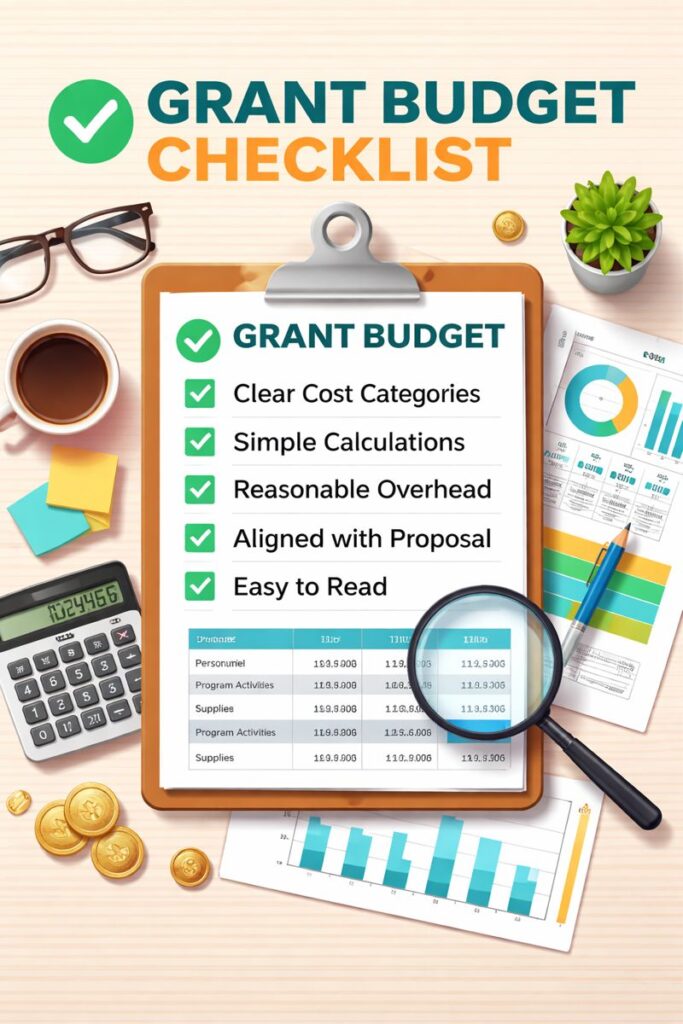
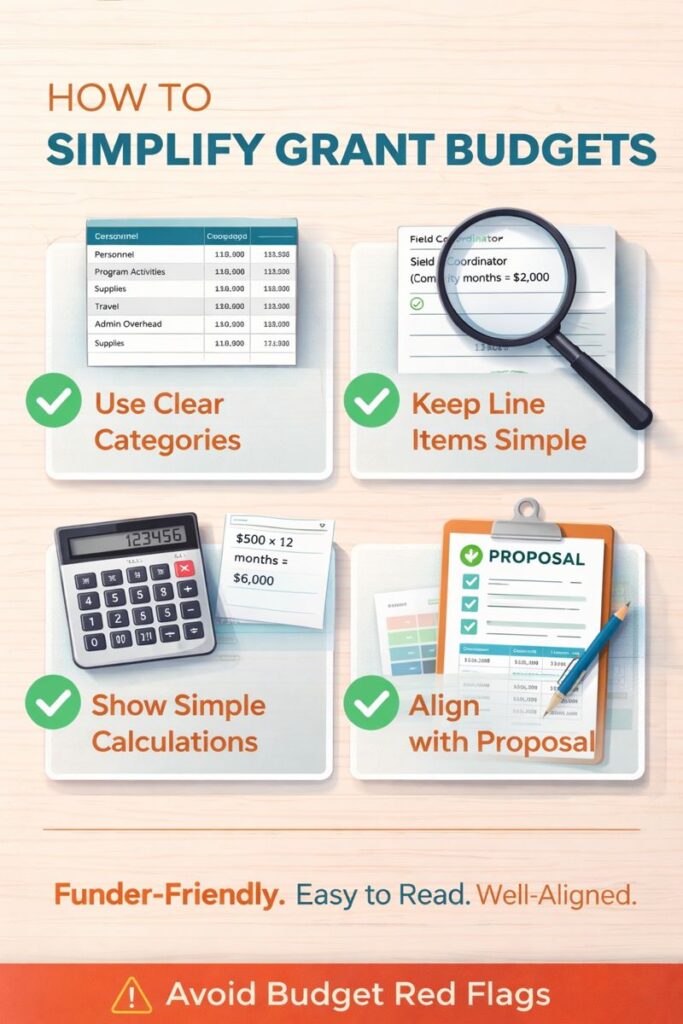
1. Clear Cost Categories (5–7 Max)
Avoid clutter. Use high-level categories funders expect:
- Personnel
- Program Activities
- Supplies & Materials
- Travel (if essential)
- Monitoring & Evaluation
- Administration/Overhead
If you need more than seven categories, your budget is probably too complex.
2. Line Items That Tell a Story
Each line item should answer one silent funder question:
Why does this cost exist?
Bad example:
- “Consultant Fees – $25,000”
Better example:
- “Monitoring & Evaluation Consultant (Project Impact Assessment) – $25,000”
The second version builds trust instantly.
3. Simple Calculations (Visible Logic)
Always show how numbers were calculated:
- Salary × % of time
- Units × cost per unit
- Days × daily rate
Hidden math creates suspicion. Visible logic creates confidence.
4. Program-Weighted Spending
Funders prefer budgets where:
- 65–85% supports direct program activities
- Administrative costs are reasonable and clearly justified
If overhead looks bloated—or artificially low—expect scrutiny.
5. Matching Narrative Language
Your budget should mirror your proposal language.
If your proposal emphasizes:
- Capacity building → show training costs
- Community outreach → show engagement expenses
- Sustainability → show long-term investment lines
Misalignment is a silent rejection trigger.
Common Budget Mistakes That Trigger Red Flags
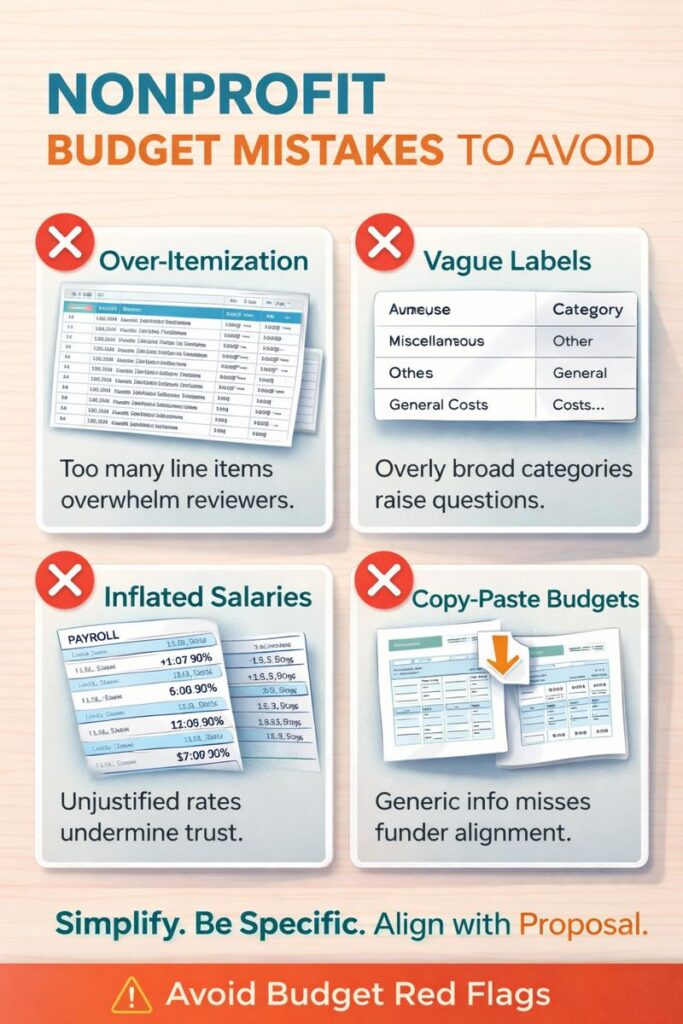
Avoid these at all costs:
❌ Over-Itemization
Breaking costs into microscopic details overwhelms reviewers.
❌ Vague Labels
“Miscellaneous,” “Other,” or “General Costs” are funder alarms.
❌ Inflated Salaries Without Context
Always justify roles, time allocation, and relevance.
❌ Copy-Paste Budgets
Funders can tell when budgets weren’t customized.
❌ Numbers That Don’t Match the Narrative
If your activities say one thing and your budget says another, trust collapses.
Budget Templates That Actually Work (3 Models)
1. The Foundation-Friendly Budget
Best for private and corporate foundations.
- Clean categories
- Minimal line items
- Emphasis on program delivery
- Light administrative framing
2. The Government-Ready Budget
Best for public agencies and multilaterals.
- Clear cost justifications
- Explicit calculation formulas
- Strong compliance structure
- Transparent overhead
3. The International Donor Budget
Best for UN agencies, USAID, EU, and global funders.
- Currency clarity
- Cost-efficiency emphasis
- Monitoring & evaluation visibility
- Sustainability signaling
Modern grant teams increasingly rely on donor-aligned systems like GrantWriterAI to generate proposals that mirror specific funder expectations, reducing revision cycles and accelerating approvals. When budgets and narratives are built from the same logic engine, misalignment disappears.
Why Faster Budgets Lead to Faster Decisions
Funders don’t approve proposals line by line.
They approve confidence.
A budget that is:
- Easy to scan
- Easy to understand
- Easy to defend
…moves your proposal from “needs review” to “ready for approval” far faster.
In competitive funding cycles, speed matters.
The Hidden Advantage of Budget Templates
Reusable budget templates:
- Reduce staff burnout
- Prevent errors under deadline pressure
- Ensure consistency across proposals
- Allow non-financial staff to contribute
This is why high-performing nonprofits focus less on “perfect budgets” and more on repeatable budget systems.
The Future of Grant Budgets: Simpler, Smarter, Aligned
Funders are not asking for more complexity.
They’re asking for:
- Better alignment
- Clearer thinking
- Faster decisions
Budget templates that make funders say YES faster don’t impress with detail—they reassure with clarity.
When budgets feel human, intentional, and grounded, approvals follow.
Your budget is not an afterthought.
It’s a decision accelerator.
When you replace complexity with clarity, and confusion with confidence, funders don’t just understand your proposal—they trust it.
Strategic Next Step
When you’re ready to increase proposal volume, reduce budget confusion, and align instantly with donor expectations, explore GrantWriterAI and start free here.
Because great programs deserve budgets that help them get funded—faster.
Frequently Asked Questions (FAQs)
1. How detailed should a grant budget be?
Detailed enough to show logic, but simple enough to understand in one minute.
2. Are complex spreadsheets a good idea?
No. Complexity increases review time and rejection risk.
3. What percentage should go to overhead?
Typically 10–25%, depending on the funder and project type.
4. Do funders prefer itemized or summarized budgets?
Most prefer summarized budgets with visible calculations.
5. Should each proposal have a custom budget?
Yes—but built from a reusable template, not from scratch.
6. Are budget narratives important?
Yes. They explain why costs exist and build trust.
7. What’s the biggest budget red flag for funders?
Vague categories and unexplained costs.
8. Can interns or volunteers help with budgets?
Yes, if guided by clear templates and donor-aligned systems.
9. How do I align budgets with proposal narratives?
Use the same language, priorities, and structure across both.
10. Can AI help with grant budgets?
Yes. When used ethically, AI can standardize templates, mirror donor language, and reduce costly revisions—especially at scale.