Solving the Hidden Chaos That Stops Nonprofits From Winning More Grants
Grant funding is not lost because nonprofits lack passion, impact, or ideas. It’s lost because of internal chaos.
Missed deadlines. Duplicate work. Conflicting document versions. Overworked staff scrambling at the last minute. Sound familiar?
If your organization submits only a handful of grants per year—not because of opportunity, but because of internal bottlenecks—this article is for you.
In this guide, you’ll learn how to build internal processes for scalable grant submission, so your organization can move from reactive, chaotic workflows to calm, repeatable, high-volume grant production—without hiring an army of writers.
Also Read: How to Balance Storytelling and Data in Proposals
Why Workflow Chaos Is the Silent Grant Killer
Most nonprofits don’t have a grant-writing problem. They have a process problem.
Common symptoms include:
- No centralized grant calendar
- Grant knowledge living in one person’s head
- Last-minute data requests to program staff
- Rewriting the same organizational narrative repeatedly
- Burnout among development teams
Chaos doesn’t just reduce efficiency—it limits scale.
You cannot submit 20, 40, or 100 grants per year using the same informal systems designed for five.
Scalable grant submission requires infrastructure, not heroics.
The Core Principle: Grants Are a System, Not a Project
Before building processes, adopt this mindset shift:
Grant writing is not a creative event. It is a repeatable operational system.
That system has inputs (data, programs, metrics), processes (drafting, review, compliance), and outputs (submitted proposals).
Once you treat grants as a system, clarity follows.
Step 1: Centralize Grant Intelligence
Scalable processes begin with shared visibility.
What to Centralize
- Active and upcoming funding opportunities
- Deadlines and submission portals
- Eligibility requirements
- Donor priorities and language preferences
- Historical submissions and outcomes
Best Practice
Use a single source of truth—whether a CRM, shared drive, or grant platform—to eliminate silos.
When everyone sees the same pipeline, chaos disappears.
Step 2: Build Modular Grant Components (Stop Rewriting Everything)
One of the biggest causes of workflow breakdown is reinvention.
Every proposal contains repeatable elements:
- Organizational background
- Mission and vision
- DEI statements
- Monitoring & evaluation frameworks
- Financial narratives
Instead of rewriting, modularize.
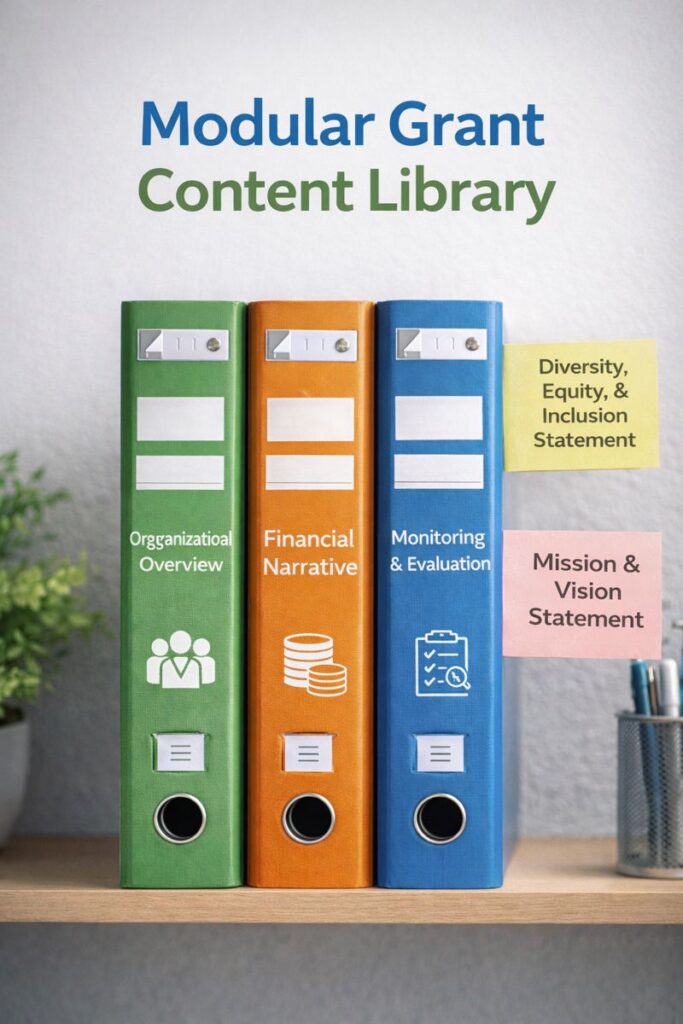
Create a Grant Content Library
Develop reusable, donor-aligned components that can be customized—not rebuilt—for each opportunity.
This single step can cut proposal development time by 50–70%.
Step 3: Define Clear Roles (No More “Everyone Does Everything”)
Chaos thrives in ambiguity.
Define ownership across the grant lifecycle:
| Role | Responsibility |
| Grant Lead | Opportunity screening, timeline management |
| Program Staff | Technical inputs, outcomes, indicators |
| Finance | Budgets, cost narratives |
| Reviewer | Compliance and alignment checks |
| Approver | Final sign-off |
When roles are clear, momentum replaces confusion.
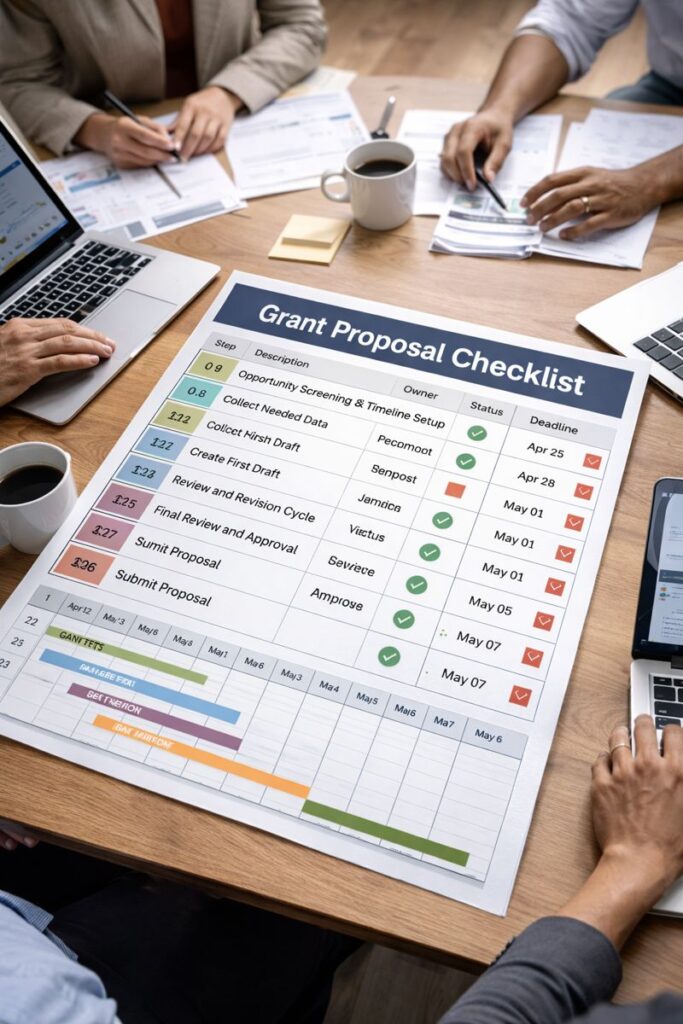
Step 4: Standardize Timelines and Checkpoints
Scalable grant submission requires predictable cadence.
Example Grant Timeline
- Day 1–2: Opportunity screening
- Day 3–5: Program inputs collected
- Day 6–10: Draft development
- Day 11–12: Review and revisions
- Day 13: Final compliance check
- Day 14: Submission
Repeatable timelines reduce stress and protect quality.
Step 5: Design for Volume, Not Perfection
Many nonprofits unknowingly sabotage scale by chasing perfection.
Here’s the truth:
Grant funding is a probability game. Volume wins.
High-performing organizations submit more donor-aligned proposals, not “perfect” ones.
That’s why modern nonprofits are shifting toward platforms like GrantWriterAI—not to replace humans, but to unlock volume without burnout.
GrantWriterAI enables teams to:
- Produce 3×–10× more proposals
- Maintain donor-aligned tone automatically
- Reduce dependency on expensive external writers
- Allow staff, interns, and volunteers to contribute safely
Scalability requires tools that support systems—not heroic effort.
Step 6: Embed Donor Alignment Into the Process
Workflow chaos often comes from misalignment with donors—leading to endless revisions.
Scalable processes embed donor language upfront.
How to Do This
- Maintain donor profiles with tone, priorities, and formatting preferences
- Adapt spelling, terminology, and framing (U.S., U.K., EU, global donors)
- Mirror logic models and outcomes donors expect
Advanced platforms like GrantWriterAI automate this alignment through tone-mirroring engines trained on major donors—reducing back-and-forth and rejection risk.
Step 7: Track Metrics That Actually Matter
Scalable systems improve because they are measured.
Track:
- Proposals submitted per month
- Average time per proposal
- Cost per submission
- Win rates by donor type
- Bottlenecks in review or approval
These insights reveal exactly where chaos still exists—and how to fix it.
Step 8: Build Institutional Memory (Not Individual Dependency)
If one staff member leaving would cripple your grant operation, you don’t have a process—you have a vulnerability.
Scalable internal systems:
- Document workflows
- Store decisions and rationale
- Preserve institutional language
- Train new contributors quickly
This is where AI-assisted platforms become infrastructure—not tools—because they store and replicate organizational intelligence.
Step 9: Protect Your Team From Burnout
Burnout is not a staffing issue. It’s a systems failure.
Signs your processes are unsustainable:
- Chronic deadline stress
- Emotional fatigue around grants
- Grant work always “urgent”
- Talented staff disengaging
Scalable systems lower cognitive load and restore focus to strategy and impact.
Step 10: Treat Grant Submission as a Growth Engine
When internal processes are strong:
- Grant writing becomes predictable
- Teams collaborate instead of firefight
- Volume increases without cost explosion
- Funding becomes a growth lever, not a gamble
This is how mature nonprofits operate.
The Bottom Line
If your grant workflow feels chaotic, the solution isn’t harder work—it’s better systems.
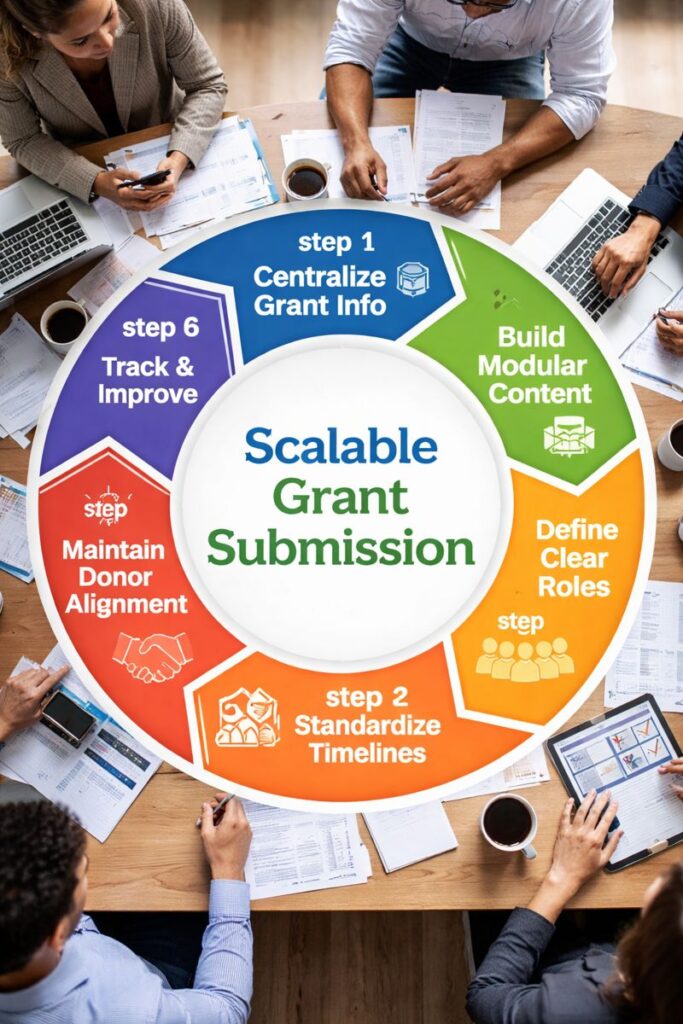
Scalable grant submission requires:
- Centralized intelligence
- Modular content
- Clear roles
- Standard timelines
- Donor-aligned language
- Technology that supports scale
When processes replace panic, funding follows.
Scaling grant funding doesn’t require more exhaustion—it requires smarter systems.
When you’re ready to increase proposal volume, reduce internal chaos, and align effortlessly with donor expectations, explore GrantWriterAI and start for free here.
Build systems. Win consistently. Protect your team.
Frequently Asked Questions (FAQs)
1. What causes workflow chaos in grant writing?
Lack of centralized systems, unclear roles, last-minute data collection, and rewriting content from scratch.
2. How many grants can a nonprofit realistically submit?
With scalable systems, organizations can submit 3–10× more grants without adding staff.
3. Do small nonprofits need internal grant processes?
Yes. Strong processes matter even more when resources are limited.
4. How do modular grant components work?
They allow teams to reuse core narratives while tailoring them to specific donors.
5. Can interns or volunteers help with grants?
Yes—when systems and tools guide structure and quality control.
6. How do you maintain donor alignment at scale?
By embedding donor profiles, tone, and priorities directly into workflows.
7. What tools support scalable grant submission?
Grant CRMs, content libraries, and AI-driven platforms like GrantWriterAI.
8. Does AI replace grant writers?
No. It amplifies teams, reduces manual work, and protects strategic thinking.
9. How do you reduce burnout in development teams?
By removing chaos through standardized timelines, clarity, and automation.
10. What’s the first step to scaling grant submissions?
Centralizing opportunities and building a repeatable process.