
Funders don’t reject proposals because nonprofits lack passion or impact. They reject them because the executive summary didn’t make them care fast enough.
In today’s hyper-competitive funding environment, reviewers often skim dozens—sometimes hundreds—of proposals under tight deadlines. The executive summary is usually the first—and sometimes only—section read in full.
If your summary feels vague, overly technical, or generic, the proposal is quietly deprioritized. Not because your mission isn’t worthy—but because the story didn’t land.
This article will show you how to write a strong executive summary that gets funders excited, emotionally engaged, and eager to keep reading—without exaggeration, fluff, or desperation.
Also Read: How to Find High-Value Grants for Faith-Based Organizations
What Is an Executive Summary (From a Funder’s Perspective)?
Nonprofits often misunderstand the role of an executive summary. It is not:
- A condensed table of contents
- A mission statement copy-paste
- A compliance formality
To a funder, the executive summary answers one question:
“Is this proposal worth my time and money?”
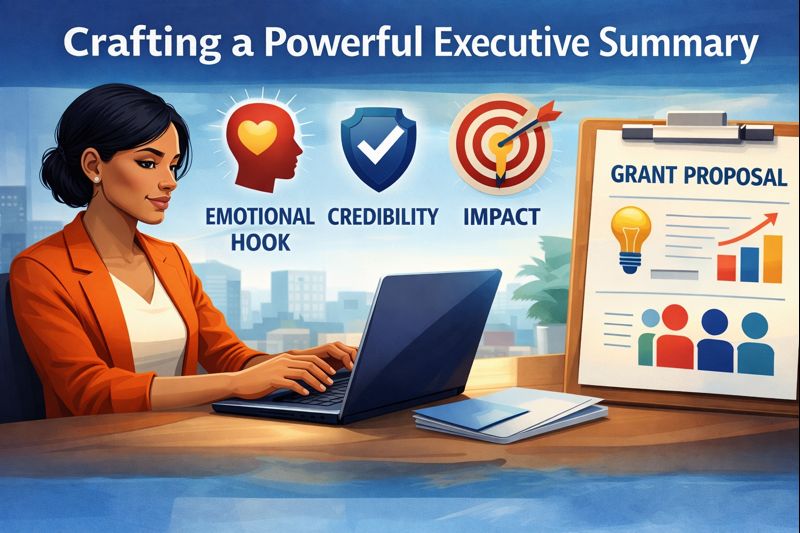
A strong executive summary does three things simultaneously:
- Creates emotional clarity – Why this problem matters now
- Establishes credibility – Why you are equipped to solve it
- Signals impact – What meaningful change their funding enables
If any one of these is missing, excitement fades.
The Core Pain Point: Why Summaries Fail to Hook Funders
Let’s name the real problem.
Most executive summaries fail because they are written for compliance, not persuasion.
Common mistakes include:
- Leading with organizational history instead of urgency
- Overloading jargon, statistics, or acronyms
- Describing activities instead of outcomes
- Sounding cautious, abstract, or emotionally flat
Funders are human. They are moved by clarity, confidence, and purpose—not by safe, bureaucratic language.
The Psychology of a Fundable Executive Summary
To write a summary that excites funders, you need to understand how they read.
Funders scan for:
- Relevance: Does this align with our priorities?
- Urgency: Why does this matter now?
- Confidence: Does this organization sound capable and prepared?
- Return on Impact: What changes if we say yes?
Your summary must deliver all four—quickly.
The 6-Part Framework for a Strong Executive Summary
Below is a proven structure used by high-performing grant writers and donor-aligned organizations globally.
1. Start With the Problem—Not Your Organization
The opening paragraph should immediately surface a human-centered problem, not an internal description of your nonprofit.
❌ Weak opening:
“Founded in 2012, XYZ Organization is a nonprofit dedicated to community development…”
✅ Strong opening:
“In [community/region], over 60% of [target population] lack access to [critical service], limiting their ability to [desired outcome].”
Why this works:
Funders fund solutions to problems, not organizations in isolation.
2. Establish Urgency Without Alarmism
Urgency is not panic. It’s timing.
Explain why the problem matters now:
- A policy change
- A funding gap
- A growing population need
- A narrowing window for intervention
Example:
“Without immediate intervention, the next 12 months will determine whether [population] experiences recovery or long-term harm.”
This positions your proposal as timely, not optional.
3. Introduce Your Solution With Confidence
Only after the problem is clear should you introduce your organization and program.
Focus on what you do differently or effectively, not everything you do.
Key elements to include:
- Program name or initiative
- Target population
- Geographic scope
- Core intervention
Example:
“To address this gap, XYZ Organization will implement [program], providing [specific service] to [number] individuals across [region].”
Avoid phrases like “we hope to” or “we aim to”. Confidence signals readiness.
4. Demonstrate Credibility (Briefly but Clearly)
Funders want reassurance, not resumes.
In 1–2 sentences, establish credibility through:
- Years of experience
- Proven results
- Strategic partnerships
- Past funding or scaling success
Example:
“With over 10 years of experience and a 92% program completion rate, XYZ Organization has successfully delivered similar initiatives across three regions.”
This reduces perceived risk.
5. Make the Impact Tangible
Abstract impact kills excitement.
Instead of:
“This program will empower communities.”
Use:
“As a result, 1,200 households will gain consistent access to clean water, reducing waterborne illness by an estimated 40% within the first year.”
Numbers help—but only when tied to real-world change.
6. End With the Funder’s Role in the Story
The final paragraph should subtly answer:
“What does our funding make possible?”
Position the funder as an enabler of transformation—not just a check writer.
Example:
“This investment will ensure that [outcome] becomes a sustainable reality for [population], creating a model that can be replicated beyond the grant period.”
End with confidence, not gratitude.
Length Matters: How Long Should an Executive Summary Be?
Most strong executive summaries fall between:
- 300–500 words (unless the funder specifies otherwise)
Too short feels shallow.
Too long feels unfocused.
Every sentence must earn its place.
Tone That Excites Funders (Without Overselling)
Funders are allergic to hype.
Aim for a tone that is:
- Clear
- Grounded
- Human
- Donor-aligned
Avoid:
- Excessive superlatives
- Emotional manipulation
- Overpromising outcomes
The goal is quiet confidence, not marketing copy.
Why Alignment Matters More Than Eloquence
A beautifully written executive summary can still fail if it doesn’t mirror funder language and priorities.
High-performing organizations increasingly use AI-driven systems to:
- Mirror donor tone
- Adapt to U.S., U.K., EU, or multilateral funders
- Align outcomes with funder frameworks
Platforms like GrantWriterAI help nonprofits generate executive summaries that reflect donor expectations while maintaining organizational voice—reducing rewrites and increasing proposal volume without burnout.
Final Checklist: Before You Submit
Before submitting your executive summary, ask:
- Can a funder understand the problem in 30 seconds?
- Is the urgency clear without sounding desperate?
- Does the solution feel realistic and fundable?
- Is the impact specific and meaningful?
- Does this make someone want to read the full proposal?
If the answer to any is no, revise.
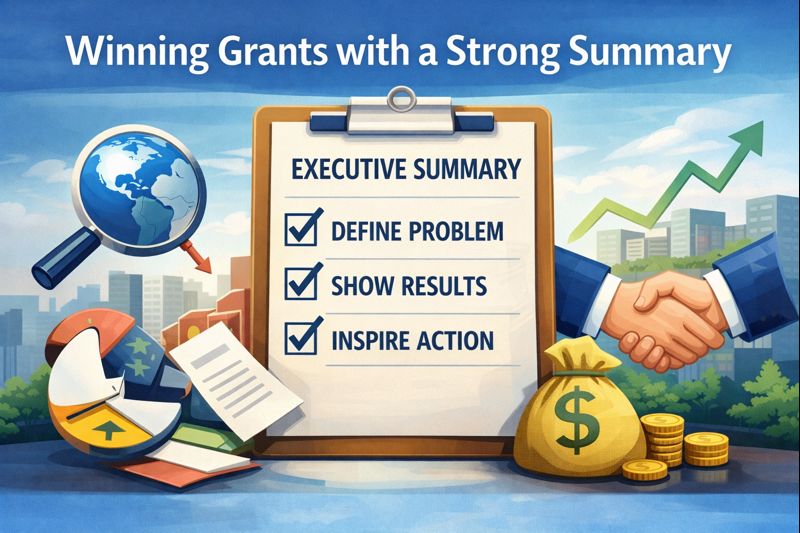
Your Executive Summary Is Not a Summary—It’s a Decision Point
A strong executive summary doesn’t summarize your proposal.
It earns attention, builds trust, and invites belief.
When written strategically, it transforms your proposal from “another application” into a compelling opportunity for impact.
And when you’re ready to scale high-quality, donor-aligned executive summaries without scaling stress or staffing costs, tools like GrantWriterAI make it possible to increase proposal volume while maintaining clarity, confidence, and credibility.
👉 When you’re ready to scale your funding without scaling burnout, explore GrantWriterAI and start free here.
Frequently Asked Questions
1. How long should an executive summary be for a grant proposal?
Most funders expect 300–500 words, unless otherwise stated in the guidelines.
2. What is the main purpose of an executive summary?
Its purpose is to convince funders to read the full proposal by clearly presenting the problem, solution, and impact.
3. Why do funders prioritize the executive summary?
Because it helps them quickly assess relevance, urgency, and funding potential.
4. Should the executive summary include statistics?
Yes, but only high-impact, relevant data that strengthens urgency and credibility.
5. What should come first: the problem or the organization?
Always start with the problem, not your organization.
6. Can one executive summary be reused for multiple grants?
No. Each summary should be tailored to the funder’s priorities and language.
7. How do you make an executive summary engaging without overselling?
Use clear outcomes, confident tone, and evidence-based impact instead of hype.
8. What tone works best for executive summaries?
A tone that is clear, calm, confident, and donor-aligned.
9. What is the biggest mistake nonprofits make in executive summaries?
Writing them as a formality instead of a persuasion tool.
10. Can AI help improve executive summaries for grants?
Yes. Purpose-built tools like GrantWriterAI help align tone and structure with funder expectations while saving time.