
How Ministries Can Stay Fundable as Donor Priorities Constantly Shift
Faith-based organizations have always operated at the intersection of mission and mercy. But in 2026, that intersection is narrower—and more competitive—than ever.
Grant priorities are no longer stable. What funders supported three years ago may now be considered outdated, misaligned, or too narrowly defined. For ministries, churches, and faith-based nonprofits, this creates a persistent pain point:
You’re doing meaningful work—but the funding criteria keep changing.
This blog unpacks priority strategies for faith-based grant writing in 2026, helping ministries remain fundable, compliant, and compelling even as donor agendas evolve.
Why Faith-Based Grant Writing Is Harder in 2026
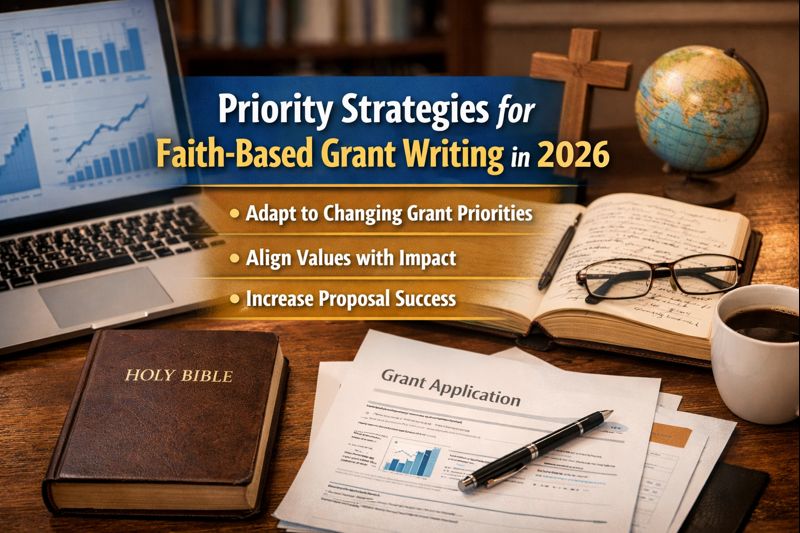
Grantmakers today are operating under new pressures:
- Political and regulatory scrutiny
- Outcome-driven philanthropy
- ESG, DEI, and climate-aligned funding frameworks
- Demand for measurable, secular-facing impact
- Shorter funding cycles and pilot-first grants
For faith-based organizations, this creates a tension:
How do you remain authentically faith-driven while aligning with funders who may avoid overt religious language?
The answer is not dilution—it’s translation.
Also Read: Email Sequences That Convert Subscribers Into Donors
Strategy 1: Shift From “Faith-Forward” Language to “Values-Driven” Impact
In 2026, most major institutional donors are not funding theology. They are funding outcomes.
That doesn’t mean abandoning faith. It means reframing it.
What This Looks Like in Practice
Instead of:
“Our ministry serves communities through Christ-centered outreach.”
Use:
“Our organization delivers community-based services rooted in compassion, dignity, and long-term human development.”
The faith remains. The framing evolves.
Why This Matters
Funders increasingly require proposals to:
- Avoid exclusionary language
- Demonstrate universal benefit
- Show public or community-wide value
Values-driven framing allows faith-based organizations to stay authentic while remaining funder-aligned.
Strategy 2: Track Grant Priorities Like a Living System—Not a Static List
One of the biggest mistakes faith-based nonprofits make is treating grant research as a one-time task.
In 2026, priorities shift quarterly, not annually.
What’s Changing Faster Than Ever
- Geographic focus areas
- Target populations (youth, migrants, women, climate-affected communities)
- Thematic emphasis (resilience, mental health, workforce development)
- Reporting and compliance thresholds
The Strategic Shift
Instead of asking:
“Which grants fit our mission?”
High-performing organizations ask:
“How does our mission intersect with this year’s priorities?”
This requires:
- Continuous monitoring
- Proposal adaptability
- Modular program descriptions
Strategy 3: Build Program Narratives That Can Be Reconfigured
In 2026, funders want custom alignment, not generic proposals.
Faith-based organizations must design programs that can be repositioned without being reinvented.
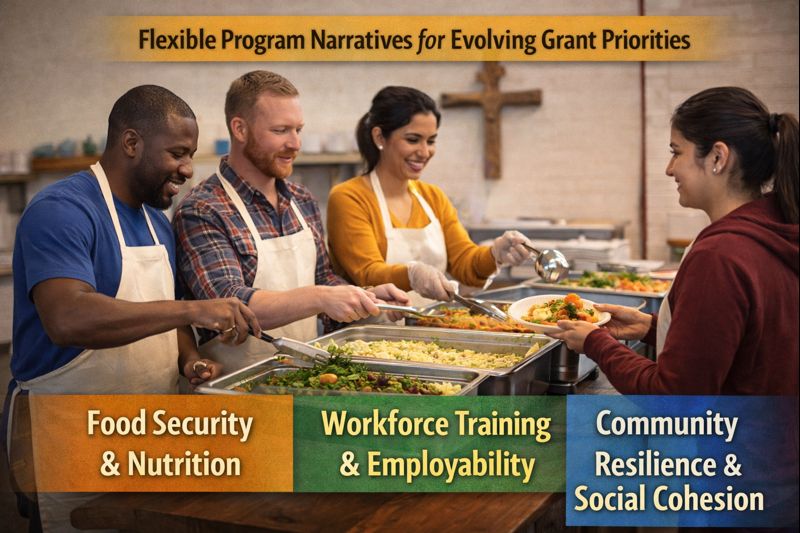
Example: One Program, Three Priority Angles
A church-led community kitchen can be framed as:
- Food security and nutrition (public health funders)
- Workforce training and employability (economic development donors)
- Community resilience and social cohesion (local government grants)
The service stays the same.
The narrative adapts.
This modular storytelling approach is now essential for sustainable grant funding.
Strategy 4: Lead With Data—Then Ground It in Human Dignity
Donors in 2026 expect data fluency.
But faith-based organizations bring something many secular nonprofits lack: moral credibility and trust.
The winning formula is not one or the other—it’s both.
What Funders Want to See
- Clear problem statements
- Measurable outputs and outcomes
- Evidence-informed program design
- Ethical service delivery
What Faith-Based Organizations Add
- Deep community access
- Long-term presence
- Trust with marginalized populations
- Volunteer and congregational infrastructure
When grant proposals integrate data + dignity, they stand out.
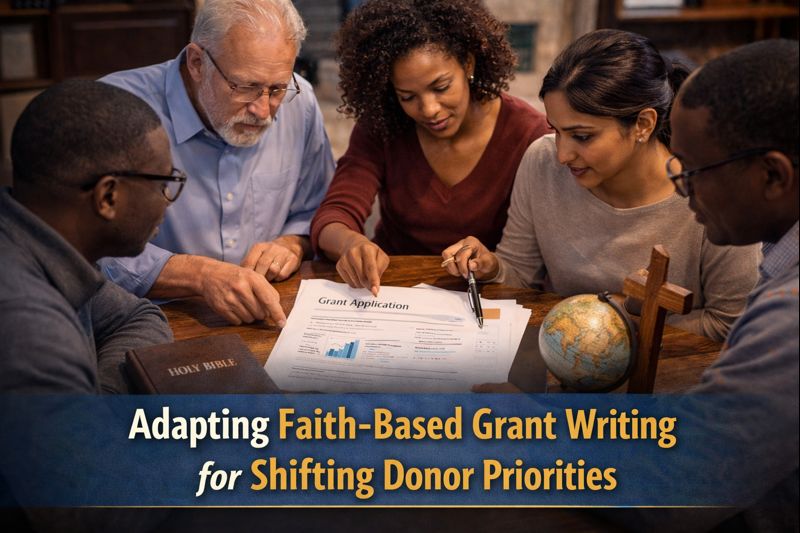
Strategy 5: Prepare for Increased Scrutiny Around Church-State Separation
In 2026, compliance expectations are higher—especially for organizations with religious affiliations.
This doesn’t mean faith-based organizations are excluded. It means clarity is required.
Best Practices
- Clearly separate religious activities from grant-funded services
- Explicitly state non-discrimination policies
- Document governance and financial controls
- Demonstrate public benefit independent of faith participation
Organizations that proactively address these areas reduce risk and increase funder confidence.
Strategy 6: Increase Proposal Volume Without Increasing Burnout
Here’s the uncomfortable truth:
In 2026, funding success is increasingly governed by the law of averages.
More aligned proposals = higher probability of awards.
But most faith-based organizations are already stretched thin.
The Bottleneck
- Limited staff capacity
- Volunteer burnout
- High cost of professional grant writers
- Long turnaround times
The Strategic Shift
Forward-looking ministries are adopting AI-assisted grant writing systems to:
- Produce more proposals
- Customize language for each donor
- Reduce dependency on single writers
- Maintain institutional memory
This is not about replacing people.
It’s about removing friction.
Platforms like GrantWriterAI are increasingly used by faith-based nonprofits to scale proposal output while maintaining donor-aligned tone, compliance, and clarity—especially as priorities shift faster than human teams can track alone.
Strategy 7: Align With Global and National Priority Themes for 2026
While local context matters, 2026 funding priorities show consistent patterns across major donors.
Faith-based organizations that map their work to these themes are more competitive.
High-Priority Themes in 2026
- Mental health and psychosocial support
- Youth workforce readiness
- Migration and refugee integration
- Climate resilience at the community level
- Gender equity and family stability
- Faith-sensitive humanitarian delivery
The key is not chasing trends—but articulating how existing programs already contribute to these outcomes.
Strategy 8: Treat Grant Writing as Infrastructure, Not a Side Task
In the past, grant writing was often an “extra” responsibility.
In 2026, it is infrastructure.
High-performing faith-based organizations now treat grant systems the same way they treat:
- Financial management
- Program evaluation
- Donor relations
This includes:
- Standardized narratives
- Outcome libraries
- Priority tracking systems
- Proposal production workflows
When grant writing becomes infrastructure, shifting priorities become manageable—not destabilizing.
The Bigger Picture: Faith-Based Organizations Are Still Essential
Despite changing donor language and evolving priorities, faith-based organizations remain indispensable.
They:
- Reach populations others can’t
- Stay when funding cycles end
- Serve without headlines
- Anchor communities in crisis
The challenge of 2026 is not relevance—it’s articulation.
Those who adapt their grant strategies without abandoning their mission will not only survive—but scale.
Grant priorities will continue to shift. That is no longer the exception—it’s the rule.
Faith-based organizations that succeed in 2026 will be those that:
- Translate faith into funder-aligned impact
- Adapt narratives without compromising values
- Increase proposal volume strategically
- Build grant capacity as a system, not a scramble
When you’re ready to scale your funding without scaling burnout, explore GrantWriterAI and begin building donor-aligned proposals designed for the realities of 2026.
Frequently Asked Questions: Faith-Based Grant Writing in 2026
1.What are the biggest changes in faith-based grant writing in 2026?
Grant priorities shift faster, funders demand measurable outcomes, and compliance expectations are higher.
2.Can faith-based organizations still receive grants?
Yes. Most foundations and government agencies still fund faith-based organizations that demonstrate public benefit and non-discrimination.
3.How can faith-based nonprofits align with grants without compromising faith?
By translating faith values into universally recognized outcomes like dignity, resilience, and community impact.
4.Why do grant priorities change so frequently?
Donors adjust priorities due to policy changes, emerging crises, data-driven philanthropy, and accountability pressures.
5.What grants are most accessible to faith-based organizations in 2026?
Mental health, food security, workforce development, youth services, migration support, and community resilience grants.
6.How can small churches compete with larger nonprofits?
By focusing on niche populations, leveraging community trust, partnering locally, and submitting more aligned proposals.
7.Is it better to submit fewer grants or more proposals?
More well-aligned proposals increase funding success due to the law of averages.
8.How often should grant narratives be updated?
At least quarterly, with customization for each funder.
9.Do funders avoid faith-based organizations?
No. Funders avoid unclear boundaries, not faith-based missions.
10.What is the biggest grant-writing mistake faith-based organizations make?
Using outdated language that no longer matches current funder priorities.