For many churches, grant writing feels less like a ministry activity and more like learning a foreign language.
Terms such as logic model, matching funds, restricted grant, or program sustainability can stop even the most committed faith leaders in their tracks. Pastors, ministry coordinators, volunteers, and church administrators often share the same frustration:
“We know our mission. We serve our community. But we don’t understand what funders are actually asking for.”
This confusion leads to missed opportunities, incomplete applications, and unnecessary reliance on expensive grant consultants.
That’s why this Ultimate Glossary of Grant Writing Terms for Churches exists.
This guide translates complex grant terminology into plain language, grounded in faith-based nonprofit realities, so your church can approach funding with confidence, clarity, and integrity.
Also Read: Grant Writing Tools You Need in Your Toolbox
How to Use This Grant Writing Glossary
You don’t need to memorize every term.
Use this glossary to:
- Understand grant guidelines
- Decode application instructions
- Communicate clearly with funders
- Train staff, interns, or volunteers
- Reduce fear and confusion around grants
Each term below is written specifically with churches and faith-based organizations in mind.
Essential Grant Writing Terms for Churches (Plain English)
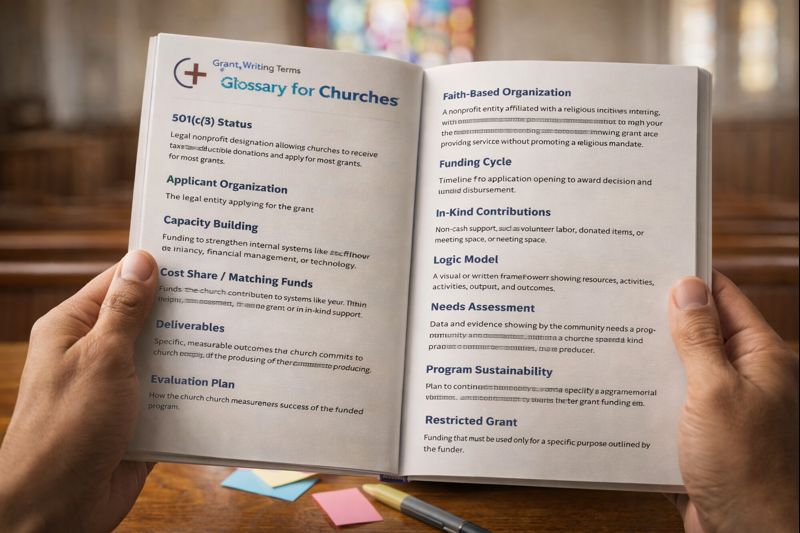
501(c)(3) Status
A legal nonprofit designation from the IRS that allows churches to receive tax-deductible donations and apply for most grants. Most churches automatically qualify, but some funders still ask for documentation.
Applicant Organization
The legal entity applying for the grant. For churches, this is usually the church itself—not the pastor or ministry leader individually.
Capacity Building
Funding designed to strengthen your church’s internal systems, such as staff training, financial systems, technology, or governance—not direct service delivery.
Community Impact
The measurable difference your church’s program makes in people’s lives—such as reduced food insecurity, improved literacy, or expanded access to counseling.
Cost Share / Matching Funds
Funds your church contributes toward the project, either in cash or in-kind (volunteer hours, donated space, equipment). Some grants require this; many do not.
Deliverables
Specific, tangible outcomes your church commits to producing—such as the number of families served, classes held, or meals distributed.
Eligibility Criteria
Rules that determine whether your church can apply, such as geographic location, population served, or program focus.
Evaluation Plan
How your church will measure success. This can be simple—attendance logs, surveys, testimonies, or progress tracking.
Faith-Based Organization (FBO)
A nonprofit entity affiliated with a religious institution. Many funders support FBOs as long as funds are used for community services, not religious instruction.
Funding Cycle
The timeline from application opening to award decision and disbursement. Some cycles are annual; others occur multiple times per year.
General Operating Support
Unrestricted funding that can be used for overall church operations, staffing, utilities, or program support—highly valuable and often overlooked.
Grant Agreement
A legal document outlining how funds must be used, reported, and managed once awarded.
Grant Narrative
The written story explaining your church’s mission, community need, program design, and expected impact.
In-Kind Contributions
Non-cash support such as volunteer labor, donated food, meeting space, or professional services.
Indirect Costs
Administrative expenses that support programs, such as accounting, utilities, or management time. Some grants allow these; others cap them.
Letter of Inquiry (LOI)
A short introductory proposal used to determine whether a funder wants a full application from your church.
Logic Model
A visual or written framework showing how your church’s resources lead to activities, outputs, and outcomes. Think of it as a “ministry roadmap.”
Needs Assessment
Data and evidence showing why your community needs this program—statistics, local reports, or congregational observations.
Outcome
The change that occurs because of your program, such as improved mental health, job readiness, or family stability.
Program Budget
A detailed financial breakdown of how grant funds will be spent, aligned directly with program activities.
Program Sustainability
Your plan to continue the ministry after grant funding ends—through donations, partnerships, or future grants.
Restricted Grant
Funding that must be used only for a specific purpose outlined by the funder.
Reporting Requirements
Updates your church must submit showing how funds were used and what outcomes were achieved.
Stakeholders
Individuals or groups invested in the program, such as church leadership, volunteers, community partners, and beneficiaries.
Unrestricted Funds
Money your church can use where it is most needed, with minimal limitations.
Why Understanding Grant Language Changes Everything for Churches
Grant writing jargon isn’t meant to exclude churches—but it often does.
Once churches understand the language, they realize:
- Funders are asking reasonable, answerable questions
- Many grants align naturally with church ministries
- Grant writing is a skill—not a mystery
- Volunteers and staff can contribute meaningfully
Language clarity leads to confidence. Confidence leads to action. Action leads to funding.
Language Should Never Limit Ministry
Churches are often doing the most impactful work in their communities—feeding families, mentoring youth, counseling the hurting, and restoring dignity.
Grant writing jargon should never be the barrier that prevents this work from being funded.
When churches understand the language, they unlock opportunity.
Strategic Next Step
When your church is ready to produce more grant-ready proposals without confusion or burnout, explore GrantWriterAI—an AI-driven, donor-aligned platform built to help faith-based and nonprofit organizations scale funding proposals with clarity and confidence.
10 Frequently Asked Questions (FAQs)
1. Can churches apply for grants?
Yes. Many foundations, corporations, and governments fund churches—especially for community service programs.
2. Do grants require churches to remove religious elements?
Grant funds cannot usually support religious instruction, but churches can maintain their identity while offering secular services.
3. Is grant writing only for large churches?
No. Many grants are designed specifically for small, rural, or under-resourced churches.
4. Do we need a professional grant writer?
Not necessarily. With the right tools and clarity, staff, volunteers, or interns can write strong proposals.
5. What is the most common mistake churches make?
Misunderstanding the funder’s language and expectations—not lack of mission or impact.
6. How long does grant writing take?
Anywhere from a few hours (LOIs) to several weeks for complex proposals. Planning reduces time dramatically.
7. What data do churches need for grants?
Basic numbers: people served, community demographics, program frequency, and outcomes—even estimates are acceptable.
8. Can churches apply for multiple grants at once?
Yes—and they should. Funding follows the law of averages.
9. Are government grants too complicated for churches?
They are more structured, but churches succeed every year with proper guidance and systems.
10. How can churches reduce grant writing burnout?
By using standardized language, templates, and systems that eliminate repetitive manual writing.