One of the most common struggles proposal writers face isn’t a lack of information—it’s knowing how to balance storytelling and data without undermining either.
Lean too hard on narrative, and funders worry your proposal lacks credibility.
Overload the document with statistics, and reviewers disengage emotionally.
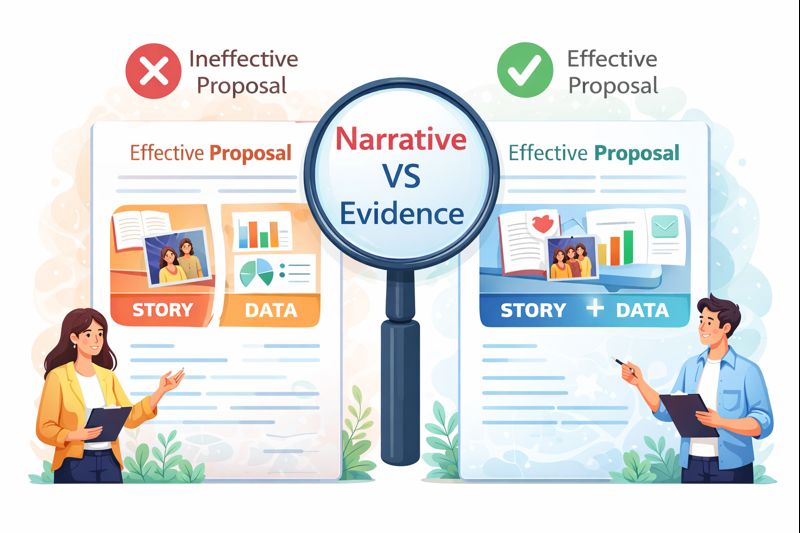
This tension—story vs. evidence—is at the heart of countless rejected proposals.
The good news? Storytelling and data are not competing forces. When integrated correctly, they become mutually reinforcing. The strongest proposals don’t choose between emotion and evidence; they sequence and structure them strategically.
This article breaks down how to balance storytelling and data in proposals, eliminate narrative vs. evidence confusion, and create funder-ready documents that persuade both the heart and the mind.
Also Read: Church Grant Writing Checklist: Never Miss a Critical Step
Why Proposals Fail When Storytelling and Data Are Misaligned

Most unsuccessful proposals fall into one of three traps:
1. The “Emotional Essay” Problem
The proposal tells a moving story—but offers little proof the organization can deliver results.
2. The “Data Dump” Problem
The proposal overwhelms reviewers with statistics, charts, and jargon—but never explains why the numbers matter.
3. The “Disconnected Mix” Problem
Stories and data both appear, but they feel stitched together rather than integrated into a cohesive argument.
Funders are trained to look for emotional relevance supported by credible evidence. When these elements feel disconnected, trust erodes.
The Core Principle: Story Leads, Data Proves
The most effective proposals follow a simple but powerful rule:
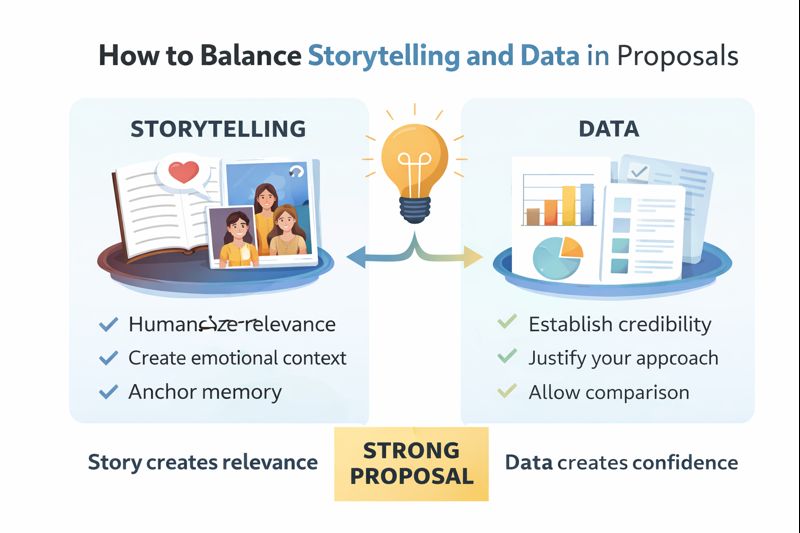
Story creates relevance. Data creates confidence.
Storytelling answers:
- Why this problem matters
- Who is affected
- Why now
Data answers:
- How big the problem is
- Why your solution works
- Why your organization is capable
Neither is optional. But they should not appear at the same time in the same way.
Understanding the Role of Storytelling in Proposals
Storytelling is not about being poetic or dramatic. In proposals, storytelling serves three strategic purposes:
1. Humanizing the Problem
Funders don’t fund statistics—they fund outcomes for people. Stories transform abstract issues into lived realities.
2. Creating Emotional Context
Stories help reviewers emotionally engage before they analyze logic.
3. Anchoring Memory
Reviewers read dozens or hundreds of proposals. Stories are what they remember.
Effective proposal storytelling is:
- Specific, not generic
- Relevant, not sentimental
- Brief, not indulgent
Understanding the Role of Data in Proposals
Data provides what storytelling cannot:
1. Credibility
Evidence shows you understand the problem and have the capacity to solve it.
2. Accountability
Funders must justify their decisions internally. Data gives them defensible rationale.
3. Comparability
Numbers allow funders to assess impact, scale, and efficiency across applicants.
Effective proposal data is:
- Relevant to the funder’s priorities
- Clearly interpreted (never raw)
- Tied directly to outcomes
The Narrative–Evidence Integration Framework
To balance storytelling and data, use this five-part integration framework:
1. Start with a Micro-Story
Open sections with a brief, representative story—a person, community, or moment.
Example:
“Maria, a 16-year-old student in rural Guatemala, walks three hours daily to attend school…”
2. Expand with Contextual Data
Immediately follow with statistics that show Maria’s story is not isolated.
Example:
“Maria’s experience reflects that of over 62% of rural students in the region who lack access to local secondary education.”
3. Present Your Solution as the Bridge
Explain how your intervention responds directly to both the story and the data.
4. Prove Effectiveness with Evidence
Use program data, evaluations, or third-party research to validate your approach.
5. Return to Human Impact
Close the section by reconnecting outcomes to people—not just numbers.
This sequencing keeps readers emotionally engaged while building rational confidence.
Where Storytelling Works Best in Proposals
Storytelling is most effective in:
- Problem statements
- Needs assessments
- Program rationale
- Beneficiary descriptions
- Opening and closing sections
Avoid overusing narrative in:
- Budgets
- Technical methodologies
- Compliance-heavy sections
Where Data Should Take the Lead
Data should dominate in:
- Program design
- Monitoring and evaluation plans
- Organizational capacity
- Past performance
- Cost-effectiveness analysis
Even here, however, data should be interpreted, not merely presented.
Common Mistakes That Create Narrative vs. Evidence Confusion
1. Using Stories as Proof
Anecdotes alone do not demonstrate impact.
2. Listing Data Without Interpretation
Numbers without explanation create cognitive fatigue.
3. Overloading One Section
Separating story in one section and dumping data in another weakens cohesion.
4. Ignoring Donor Preferences
Some funders prioritize evidence-first logic; others expect narrative framing.
High-performing teams increasingly rely on donor-aligned drafting systems—such as GrantWriterAI—to mirror funder tone, structure storytelling-data balance, and ensure proposals meet both emotional and analytical expectations without manual guesswork.
How Reviewers Actually Read Proposals
Understanding reviewer behavior clarifies why balance matters:
- Reviewers skim first
- Emotion determines initial interest
- Data determines final confidence
- Consistency determines trust
If your proposal moves reviewers emotionally but fails to reassure them intellectually, it stalls.
If it convinces them logically but fails to inspire, it blends into the pile.
A Simple Test to Check Your Balance
Before submission, ask:
- Can a reviewer summarize the human problem in one sentence?
- Can they cite one compelling statistic that proves urgency?
- Can they explain why your organization is credible?
- Can they recall a specific outcome your program delivers?
If the answer to any is “no,” the balance needs refinement.
Balance Is Strategic, Not Artistic
Balancing storytelling and data in proposals isn’t about writing talent—it’s about structure, sequencing, and intent.
When story and data work together:
- Stories attract attention
- Data sustains trust
- Proposals become persuasive, not just informative
The most successful organizations treat storytelling and evidence as a designed system, not a stylistic choice.
Frequently Asked Questions (FAQs)
1. How much storytelling should a proposal include?
Enough to humanize the problem and anchor impact, but never at the expense of clarity or evidence.
2. Can data replace storytelling in proposals?
No. Data builds confidence, but storytelling creates relevance and memorability.
3. Where should stories appear in a proposal?
Primarily in problem statements, needs assessments, and impact sections.
4. What type of data do funders value most?
Outcome data, third-party research, and evidence tied directly to program design.
5. How long should a story be in a proposal?
Typically 3–5 sentences—short, specific, and purposeful.
6. Should every section include both story and data?
Not always, but major narrative sections should integrate both.
7. How do international donors view storytelling?
Most expect restrained, evidence-backed narrative aligned with development outcomes.
8. Is qualitative data considered storytelling?
Qualitative data supports storytelling but should still be analyzed and contextualized.
9. How can teams maintain balance across multiple proposals?
Using standardized frameworks and donor-aligned drafting systems helps ensure consistency.
10. What’s the biggest mistake proposal writers make?
Assuming emotion and evidence compete instead of complementing each other.
When you’re ready to increase proposal volume without sacrificing quality—and align storytelling and data with donor expectations—explore GrantWriterAI and start free here.