Introduction: The Silent Reason Strong Proposals Still Get Rejected
Your proposal may be well-written.
Your programs may be meaningful.
Your team may be experienced.
And yet—no funding.
One of the most common (and least discussed) reasons proposals fail is this:
They describe activity instead of impact.
Donors are not buying workshops, trainings, or services.
They are investing in change.
If your proposal reads like a list of tasks instead of a story of transformation, it forces reviewers to guess your value—and busy donors never guess.
This article will show you how to clearly, confidently, and persuasively communicate impact over activity, using donor-aligned language, proven frameworks, and real-world examples.
Also Read: How to Position Your Ministry as a Funder’s Preferred Partner
Activity vs. Impact: The Distinction That Decides Funding
Before strategy, clarity.
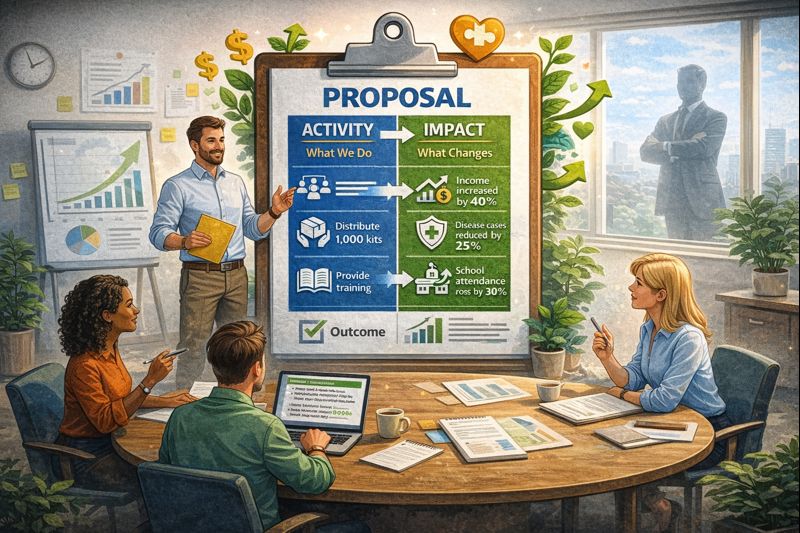
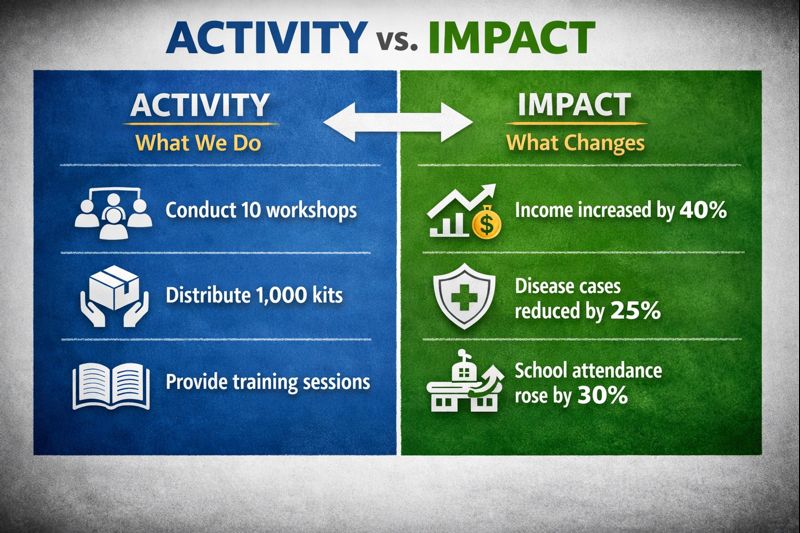
Activity = What You Do
- We trained 200 farmers
- We distributed 5,000 hygiene kits
- We held 12 community workshops
Activities describe effort, not effect.
Impact = What Changes Because You Acted
- Farmers increased household income by 32%
- Disease incidence dropped by 18% in six months
- School attendance rose from 61% to 84%
Impact describes results donors care about.
Donors do not fund motion. They fund measurable improvement in human conditions.
Why Donors Prioritize Outcomes Over Outputs
Modern funders—especially institutional and international donors—operate under pressure:
- Public accountability
- Results-based financing
- Taxpayer or board scrutiny
- Strategic impact mandates
As a result, donors increasingly ask:
- What changed because of this funding?
- Would the problem persist without this intervention?
- Can results be verified, replicated, or scaled?
A proposal heavy on activities but light on outcomes signals risk, not readiness.
The Donor’s Mental Filter (And How to Write Through It)
Every proposal is subconsciously evaluated through three donor questions:
- Relevance – Does this solve a priority problem?
- Effectiveness – Does it measurably improve conditions?
- Credibility – Can this organization deliver results?
Impact-focused communication addresses all three at once.
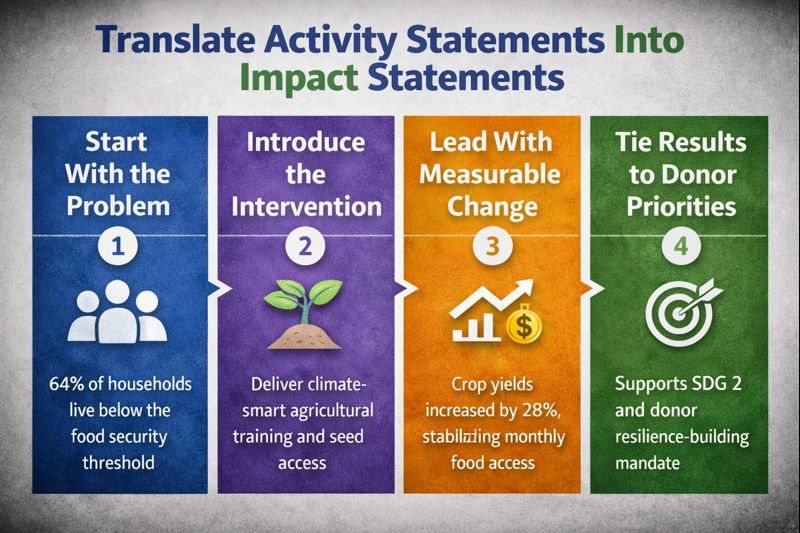
The Impact Translation Framework (Practical & Donor-Aligned)
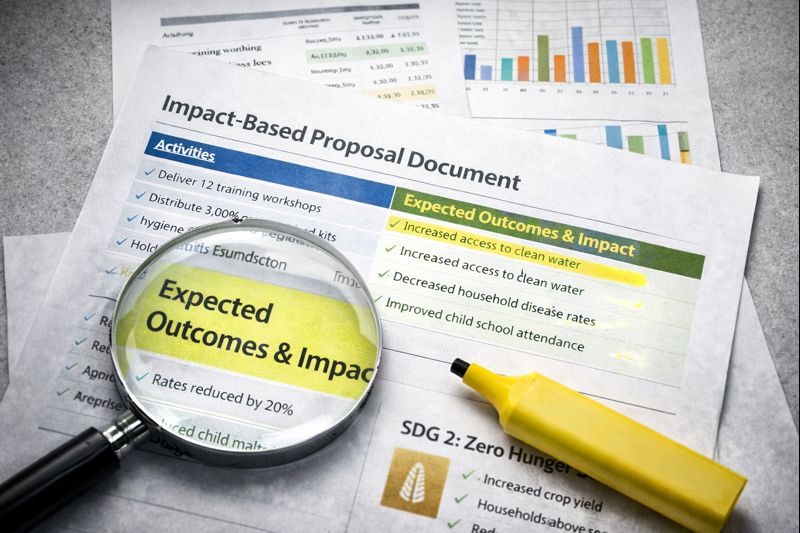
Use this simple but powerful framework to transform activity language into impact language.
Step 1: Start With the Problem Condition
Describe the current reality for beneficiaries.
“In rural District X, 64% of households live below the food security threshold.”
Step 2: Introduce the Intervention (Briefly)
Mention activities only as means, not the headline.
“The program delivers climate-smart agricultural training and seed access.”
Step 3: Lead With Measurable Change
Show what improves—and by how much.
“Within 12 months, participating households increased crop yields by 28% and stabilized monthly food access.”
Step 4: Tie Results to Donor Priorities
Explicitly connect impact to donor goals.
“These outcomes directly support SDG 2 and the donor’s resilience-building mandate.”
Rewrite Example: Activity vs. Impact
Activity-Based Statement (Weak):
“We will conduct nutrition education sessions for 500 mothers.”
Impact-Based Rewrite (Strong):
“Within six months, participating households reduced child malnutrition rates by an estimated 15% through improved feeding practices.”
Same program. Entirely different funding potential.
The Language Shift Donors Instantly Notice
Replace task-focused verbs with change-focused verbs.
| Activity Language | Impact Language |
| Conduct trainings | Improve capacity |
| Provide services | Increase access |
| Distribute supplies | Reduce vulnerability |
| Raise awareness | Change behavior |
| Hold meetings | Strengthen coordination |
This subtle shift signals strategic maturity.
How to Quantify Impact (Even When Data Is Limited)
Many nonprofits struggle here—but perfection is not required. Credibility is.
Use One of These Four Measurement Anchors:
- Baseline + Projection
“From 40% to an estimated 65% within 12 months.” - Comparative Evidence
“Based on prior pilots, similar interventions produced a 22% improvement.” - Proxy Indicators
“School attendance as a proxy for reduced child labor.” - Phased Measurement
“Initial outcomes tracked quarterly, with final evaluation at project close.”
Donors accept estimates when they are transparent and methodologically sound.
Storytelling That Communicates Impact (Without Losing Rigor)
Data convinces. Stories humanize.
The most effective proposals integrate both.
Example:
“Before the intervention, Amina’s household survived on one meal per day. Six months after enrollment, her family reports consistent food access and school re-enrollment for two children—mirroring program-wide gains across 1,200 households.”
One paragraph. Maximum resonance.
Common Mistakes That Undermine Impact Messaging
- Listing activities without explaining why they matter
- Assuming donors understand sector jargon
- Using vague terms like ‘empowered’ or ‘strengthened’ without metrics
- Burying outcomes deep in annexes instead of leading with them
- Over-claiming impact without evidence
Clarity always beats ambition.
Scaling Impact Communication Without Burning Out Your Team
High-performing organizations face a new problem:
They understand impact—but can’t communicate it fast enough.
When proposal volume increases, consistency suffers.
This is where AI-driven donor-aligned systems become infrastructure—not shortcuts.
Platforms help nonprofits translate programs into outcome-driven narratives at scale, ensuring donor language, impact framing, and tone alignment remain consistent across dozens—or hundreds—of proposals.
Not automation for speed alone—but for strategic accuracy.
Impact Is the Currency of Trust
Every donor decision is ultimately a trust decision.
Impact-focused communication says:
- We understand the problem
- We know what works
- We can prove change
When your proposal leads with outcomes instead of activities, you stop asking for funding—and start earning confidence.
Frequently Asked Questions (FAQs)
1. What is the difference between outputs and outcomes in proposals?
Outputs are immediate products (trainings, kits, sessions). Outcomes are the measurable changes that result from those outputs.
2. Can small nonprofits communicate impact without large datasets?
Yes. Use baselines, projections, proxy indicators, and transparent assumptions to demonstrate credible impact.
3. How many impact indicators should a proposal include?
Focus on 3–5 core indicators aligned with donor priorities. More is not better.
4. Should impact be mentioned in every section of a proposal?
Yes—especially in the problem statement, objectives, methodology, and monitoring sections.
5. What if a donor asks for activities specifically?
Describe activities, but always anchor them to the change they produce.
6. How do international donors evaluate impact differently?
They prioritize results-based frameworks, SDG alignment, scalability, and verification methods.
7. Is qualitative impact acceptable?
Yes, when paired with quantitative indicators or used to complement measurable results.
8. How early should impact be introduced in a proposal?
Ideally within the first page. Donors should see outcomes before details.
9. Can AI tools help with impact framing?
Yes—when designed for donor alignment and ethical use, they can dramatically improve consistency and clarity.
10. What is the fastest way to improve proposal success rates?
Shift from describing what you do to proving what changes—and scale that approach consistently.
When you’re ready to increase proposal volume, reduce writing costs, and communicate donor-aligned impact without burning out your team, explore GrantWriterAI and start free here.
Impact wins funding.
Clarity earns trust.